


Retail Glossary: 70+ Retail Services, Merchandising & Technology Terms
This is T-ROC Global’s consolidated retail glossary — a single reference for the operational, merchandising, and technology terms that show up in every retail conversation. We’ve grouped 70+ terms into eight categories so you can find what you need quickly or scan the whole landscape if you’re new to retail services.
If you’re looking for a specific service explanation, jump to our services overview. For broader guides, see our resources library.
Merchandising Terms
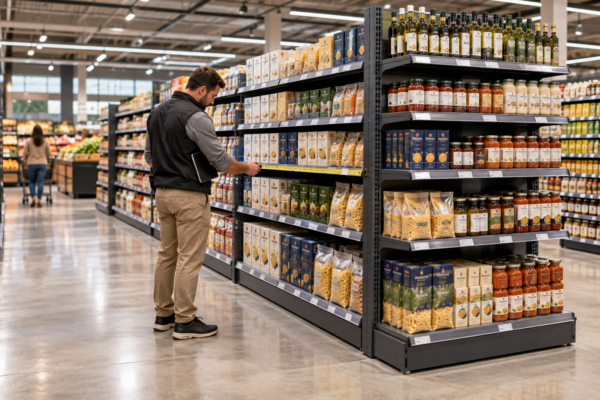
Planogram (POG): A visual diagram or schematic that specifies the exact placement of every product on a shelf, fixture, or display. Brands provide planograms to retailers; field teams ensure stores execute them correctly. See our visual merchandising services.
Retail merchandising: The discipline of choosing what products to stock, where to place them, at what price, and how to present them to maximize sales. T-ROC’s retail merchandising services include planogram execution, store resets, and compliance audits.
Visual merchandising: The creative and strategic discipline of designing in-store displays — fixtures, lighting, signage, color, focal points — to attract shoppers and drive conversions. See visual merchandising services.
Endcap: The display at the end of a retail aisle, typically used for promotional, seasonal, or high-margin products. Endcaps are the highest-value real estate in most stores.
Endcap program: A coordinated multi-store endcap deployment, usually with consistent fixturing and branded signage. Brands pay retailers for endcap placement and field teams execute the installations.
Gondola: A free-standing aisle fixture with shelving on both sides. The most common shelving unit in mass retail.
POP display (Point of Purchase): A standalone or shelf-attached display designed to drive impulse purchases at the moment of decision. Often used for new product launches.
Cross-merchandising: Placing complementary products together (e.g., wine next to cheese, gaming controllers near games) to increase basket size and tell a usage story.
Adjacency: The strategic decision about which product categories are placed next to each other in a store. Smart adjacency drives cross-category browsing.
SKU rationalization: The process of reviewing every SKU (stock-keeping unit) in a store’s assortment and removing underperformers. T-ROC field teams execute the physical cut-ins and removals.
Cut-in: The physical act of adding a new product to an existing planogram — usually requires shifting adjacent products and updating shelf labels. Done at scale during national resets.
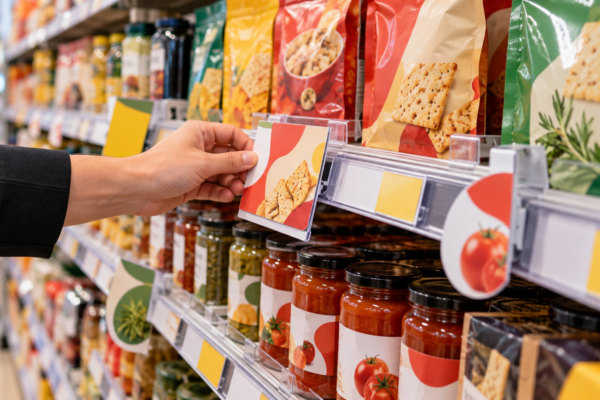
Reset: The physical execution of a planogram change. See store reset services.
Seasonal pivot: A reset triggered by a seasonal change (Black Friday, back-to-school, holiday). Every category has 6-12 critical pivot windows per year.
Brand block: A merchandising approach where all products from one brand are grouped together visually, rather than mixed with competitors. Strong brand blocks improve brand recognition and basket size.
Merchandising fixtures: The physical hardware (shelves, racks, gondolas, endcaps, peg hooks, etc.) that holds product on a retail floor. Fixture programs are the operational backbone of any merchandising strategy.
Retail Operations Terms
Retail operations: The end-to-end activities required to run a retail business — staffing, merchandising, inventory, customer service, technology, and store-level execution. See our end-to-end retail solutions.
Compliance audit: A photo-verified inspection to confirm a store is executing the brand’s standards correctly — planogram adherence, signage, fixture state, promotional execution.
Field team: The on-the-ground retail workforce that executes brand or retailer programs at the store level. Includes merchandisers, brand ambassadors, mystery shoppers, reset crews. See field teams.
Field rep: An individual member of a field team. Usually assigned to specific stores on a defined cadence.
Store reset: See “Reset” above. The physical execution of a planogram change.
Daily count: A store-level inventory count typically performed at open or close to verify on-hand quantities.
Shrink: Inventory loss from theft, damage, or administrative error. Tracked as a percentage of sales.
Markdown: A planned reduction in retail price, usually to clear seasonal or excess inventory. Field teams sometimes execute markdown signage installs.
Out of stock (OOS): A SKU is unavailable on the shelf even though the store should be carrying it. OOS rates are a critical KPI for retail execution.
On-hand: The actual inventory quantity physically present in a store, as opposed to what the inventory system claims.
Sell-through: The percentage of a product’s inventory that sold within a defined window. High sell-through indicates good demand.
Brand Ambassador & Sales Terms
Brand ambassador: A trained, paid representative who promotes a brand to consumers in-person or digitally. See brand ambassador services.
Brand ambassador program: The operational structure (recruiting, training, scheduling, technology, reporting) that runs a brand’s ambassador deployment.
Product demonstration (demo): A live, in-store showcase of a product’s features and benefits, usually performed by a trained brand ambassador or product specialist.
Sampling: Distributing free product samples in-store or at events to drive trial and awareness. Common in food, beverage, beauty, and CPG.
Lead capture: Collecting prospect contact information (email, phone, name) at retail events or activations for follow-up marketing.
Assisted sale: A sale closed with help from a trained brand ambassador or sales rep, as opposed to a self-serve transaction.
Conversion rate: The percentage of store visitors who complete a purchase. Brand ambassadors directly improve conversion in covered categories.
Attached sale: An additional product added to a transaction (accessories, warranties, complementary items). Trained ambassadors increase attach rates.
Net Promoter Score (NPS): A measure of customer satisfaction and loyalty, calculated as the percentage of promoters minus detractors.
VIBA (Virtual Interactive Brand Ambassador): T-ROC’s proprietary live-video ambassador technology that lets one expert serve customers across multiple physical retail locations. See VIBA.
Mystery Shopping & Audit Terms
Mystery shopping: The practice of deploying trained anonymous evaluators to retail locations to assess customer experience and compliance. See mystery shopping services.
Mystery shopper: An individual evaluator who visits a retail location anonymously, follows a defined scenario, and reports back on what they experienced.
Secret shopper: Synonym for mystery shopper. The terms are interchangeable.
Retail audit: A structured inspection of a retail location to assess operational compliance, merchandising execution, regulatory adherence, or customer experience.
Compliance shop: A mystery shop specifically designed to verify legal or regulatory compliance — typically age verification (alcohol, tobacco, cannabis, lottery) or accessibility compliance.
Operational audit: An inspection focused on store-level operational standards — cleanliness, staffing levels, queue times, opening/closing procedures.
Customer experience (CX) audit: A mystery shop scored against customer experience standards — greeting, product knowledge, problem resolution, complaint handling.
Retail Technology Terms
POS (Point of Sale): The hardware and software system that processes retail transactions at checkout. Modern POS systems are integrated with inventory, loyalty, and reporting.
EPOS (Electronic Point of Sale): The European/British term for what U.S. retailers usually call POS. Same concept.
BOPIS (Buy Online, Pick Up In Store): A fulfillment option where customers buy online and collect at a physical store. Major channel for modern omnichannel retail. See retail fulfillment services.
BOPAC (Buy Online, Pick Up At Curb): Curbside pickup. Same as BOPIS but with delivery to a customer’s vehicle.
Ship-from-store: A fulfillment model where ecommerce orders are picked, packed, and shipped from a retail store rather than a distribution center.
Omnichannel: An integrated retail strategy that delivers a consistent experience across all customer touchpoints — physical store, web, mobile, social, customer service.
RFID (Radio-Frequency Identification): A technology that uses tags to track inventory, prevent theft, and enable cashierless checkout. Increasingly common in apparel and luxury retail.
Self-checkout: A POS terminal where shoppers scan and pay for their own items without a cashier. Adoption is rising but so are shrink concerns.
Retail360: T-ROC’s proprietary AI-powered retail operations platform that unifies sales performance, compliance, foot traffic, inventory, and predictive analytics. See Retail360.
Field management software: Software that helps managers schedule, dispatch, track, and report on distributed retail field teams. See T-ROC Connect.
Foot traffic analytics: Measurement of how many shoppers enter a store, where they go, and how long they stay. Drives staffing and merchandising decisions.
Heat map: A visualization of foot traffic intensity across a store, used to identify high- and low-traffic zones.
Inventory & Supply Chain Terms
SKU (Stock-Keeping Unit): A unique identifier for every distinct product variation a retailer carries (size, color, model). Total SKU count is a key complexity metric.
UPC (Universal Product Code): The standardized 12-digit barcode used on most retail products. Different from a SKU — UPC is the universal identifier, SKU is the retailer’s internal one.
EAN (European Article Number): The 13-digit international version of the UPC, used outside North America.
On-shelf availability (OSA): The percentage of time a product is actually available on the shelf for purchase. OSA is the metric that out-of-stock rates measure inversely.
Lead time: The elapsed time between placing an order with a supplier and receiving the goods. Long lead times require larger safety stock.
Safety stock: Buffer inventory held to absorb demand variability and avoid stockouts.
Pick, pack, ship: The three-step warehouse process for fulfilling an order — picking the product, packing it, and shipping to the customer.
3PL (Third-Party Logistics): A provider that handles fulfillment, warehousing, and shipping on behalf of a brand or retailer.
Customer Experience Terms
Customer experience (CX): The cumulative perception customers have of a brand across all touchpoints. Includes pre-purchase, purchase, and post-purchase phases.
Shopper insights: Behavioral data about what shoppers actually do in stores — captured through observation, mystery shopping, and foot traffic analytics. See shopper insights.
Shopper journey: The path a shopper takes from initial awareness through purchase. Map the journey to identify friction points.
Path to purchase: Synonym for shopper journey, more common in CPG and retail strategy contexts.
Dwell time: How long a shopper spends in a store or specific store zone. Longer dwell time generally correlates with higher conversion.
Basket size: The average number of items per transaction, or the average dollar value per transaction (ATV — Average Transaction Value).
Average transaction value (ATV): The mean dollar value of a single retail transaction. Brand ambassadors increase ATV through attached sales.
Frequency: How often a given customer transacts with a brand or store. Loyalty programs target frequency directly.
Retention rate: The percentage of customers who continue to transact with a brand over a defined period.
Churn rate: The inverse of retention. The percentage of customers lost over a defined period.
Outsourcing & Service Industry Terms
Retail outsourcing: The practice of contracting specialized service providers to handle in-store execution that would otherwise be done in-house. T-ROC is one of the largest retail outsourcing providers in North America.
Outsourced sales: Sales execution handled by an external partner rather than internal sales staff. Common for brands selling through retail partner stores.
Outsourced staffing: Workforce capacity provided by an external partner on a flexible, as-needed basis. See on-demand retail staffing.
Field marketing: The discipline of executing marketing programs in physical retail environments — sampling, demos, brand ambassador activation, event marketing.
Field marketing agency: A service provider specializing in field marketing programs at scale.
Retail marketing services: A broad category encompassing all the services brands hire to drive in-store and adjacent retail performance — merchandising, brand ambassador work, mystery shopping, technology, analytics.
Retail-as-a-Service (RaaS): A business model where a service provider operates physical retail on behalf of a brand. The brand controls product and strategy; the operator handles staffing, technology, and operations. See Retail as a Service.
Revenue optimization: The structured discipline of maximizing revenue per store, per shopper, and per category through coordinated staffing, merchandising, technology, and shopper insight programs. See our complete guide to revenue optimization.
Compounds and Related Terms
Brick-and-mortar: Physical retail stores, as opposed to online-only commerce.
Pure play: A retailer that operates in a single channel — either only online or only physical (rare). Most modern retailers are omnichannel.
Big box: Large-format retail stores typically over 25,000 square feet. Examples: Walmart, Target, Costco, Best Buy.
Specialty retail: Stores focused on a specific category or niche — pet, sporting goods, hobby, beauty, electronics, etc.
Quick-service restaurant (QSR): Fast food and fast-casual restaurants. A major mystery shopping category for T-ROC.
Experiential retail: Retail concepts focused on creating memorable, interactive experiences rather than pure transactions. Includes pop-ups, brand experience centers, and immersive store concepts. See experiential retail services.
Pop-up store: A temporary retail concept, typically running 4-12 weeks, used for product launches, brand activations, or testing new markets.
Roadshow: A multi-city traveling brand activation, usually running consecutively at trade shows, sports events, or sponsored venues.
Activation: A time-bounded marketing program designed to drive a specific outcome — product launch, brand reintroduction, category education.
How to Use This Glossary
Most retail conversations cross multiple categories. A “national reset” combines merchandising terms (planogram, fixture, cut-in), operational terms (field team, compliance audit), and technology terms (POS update, planogram software). The terms above are linked in practice even when they’re organized separately here.
If you have a specific retail challenge and want to talk through which T-ROC services apply, schedule a conversation. Our team works at the intersection of every category in this glossary every day.
Beyond the glossary
The decision-stage content below covers the practical frameworks senior teams apply when these terms move from definitions to budget and vendor decisions.
Browse the complete T-ROC site index →
Full Definitions Library
Every term above in depth. Each entry is a full explanation with examples,
use cases and how it applies to retail operations.
- Assisted Selling
- Brand Ambassador
- Brand Ambassador Program
- Category Management in Retail
- Channel Management
- Click and Collect
- Consumer Behavior in Retail
- Consumer Packaged Goods (CPG)
- Customer Experience in Retail
- Customer Lifetime Value
- Demand Generation in Retail
- Experiential Retail
- Field Merchandising
- Field Sales Outsourcing
- Field Sales Team
- In-Store Marketing
- Mystery Shopper
- Mystery Shopping
- Mystery Shopping Company
- Omnichannel Retail
- Planogram
- Point of Sale (POS) in Retail
- Private Label
- Product Specialist
- Retail Analytics
- Retail Audit
- Retail Compliance
- Retail Conversion Rate
- Retail Customer Experience
- Retail Execution
- Retail Field Services
- Retail Field Team
- Retail Inventory Management
- Retail Loss Prevention
- Retail Merchandiser
- Retail Merchandising
- Retail Operations
- Retail Outsourcing
- Retail Price Optimization
- Retail Sales Training
- Retail Shrinkage
- Retail Staffing
- Retail Supply Chain
- Retail Technology
- Retail Workforce Management
- Sales Representative
- Sell-Through Rate
- Shopper Marketing
- Store Within a Store
- Trade Marketing in Retail
- Vendor Managed Inventory (VMI)
- Visual Merchandising