

What is a Brand Ambassador Program? (Complete Guide for Retail Brands)
A brand ambassador program is one of the highest-ROI tools available to retail brand managers — yet it remains one of the most misunderstood. This guide delivers a precise brand ambassador program definition, explains how brand ambassador programs work in a retail context, and covers everything you need to make a confident decision for your brand.
Brand Ambassador Program Definition
A brand ambassador program is a structured, managed deployment of trained individuals who represent your brand at retail locations, events, or digital channels. The defining characteristic is structure: a true program encompasses formal recruitment criteria, a standardized training curriculum, ongoing performance management, and a reporting cadence that links ambassador activity to measurable business outcomes.
This definition distinguishes a brand ambassador program from ad-hoc promotional staffing or one-off product demonstrations. Those are tactics. A brand ambassador program is a sustained operational capability that runs continuously, improves over time, and functions as a performance-marketing channel with measurable ROI.
Unlike a general retail floor associate who carries dozens of brands simultaneously, a brand ambassador works exclusively on behalf of your brand — educating shoppers, demonstrating product value, handling objections, and driving purchase decisions at the highest-intent moment in the customer journey.
For a comprehensive operational breakdown, see T-ROC’s Complete Brand Ambassador Program Guide.
How Brand Ambassador Programs Work (Step-by-Step, Retail Context)
- Strategy and coverage planning. Coverage decisions are driven by store-level sales data — locations with the highest foot traffic, the most competitive pressure, and the greatest revenue opportunity receive priority. Without this data foundation, coverage plans are guesswork.
- Recruitment against a defined profile. Consumer electronics programs recruit for genuine technology curiosity. Telecom programs prioritize the ability to simplify complexity. Vague hiring criteria produce inconsistent results; specific profiles produce scalable programs.
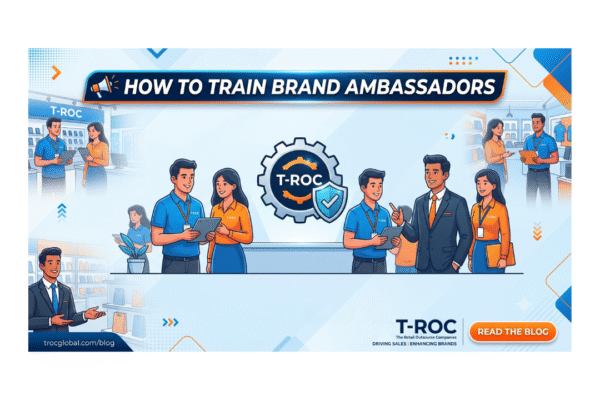
- Structured onboarding and training. Ambassadors complete a formal training curriculum covering product knowledge, brand story, objection-handling scripts, retailer protocols, and reporting tools. Training refreshes with each product update, competitive launch, and season change.
- Deployment and daily operations. Ambassadors arrive at assigned locations during peak traffic windows. On the floor, they initiate shopper conversations, conduct product demonstrations, answer questions, guide purchase decisions, and observe competitive activity.
- Reporting and performance feedback. After each shift, ambassadors log activity data: demonstrations completed, units sold, attach rates, shopper objections. Weekly or biweekly performance reviews close the feedback loop.
- Continuous optimization. Which locations underperform relative to sales potential? Which ambassadors have the highest conversion rates — and what can others learn from them? This cycle separates programs that deliver sustained ROI from those that plateau.
Types of Brand Ambassador Programs
- In-Store Demo Ambassador. Stationed at a specific retail location during peak traffic hours. Best for high-consideration products where hands-on demonstration increases purchase confidence.
- Product Specialist. Deeper technical expertise for premium categories: consumer electronics, smart home ecosystems, medical devices. More consultative, more intensive training, higher compensation. Conversion rates regularly outperform general floor staff by 25–40%.
- Roving Ambassador. Covers a territory — rotating across a set of stores within a metro area. Maximizes geographic reach when full-time dedicated placement isn’t justified at every location.
- Event and Experiential Ambassador. Deployed at trade shows, product launches, and brand activations. Mandate is awareness and trial creation at scale within a defined time window.
- Dedicated On-Site Ambassador. Full-time ambassador assigned permanently to a single high-volume location. Common in flagship big-box stores and major carrier retail outlets. Investment is higher; performance ceiling is also higher.
- Virtual Brand Ambassador. Engages online shoppers via live chat or video consultation, providing expert guidance that drives purchase confidence without in-store presence.
Benefits of Brand Ambassador Programs for Retail Brands
- Increased conversion at point of sale. Trained ambassadors consistently produce 20–40% lifts in conversion rates versus unstaffed periods at the same location.
- Higher average transaction value. Ambassadors trained in consultative selling and attachment techniques increase revenue per transaction by 15–25% through protection plan attachment, accessories, and service tier upgrades.
- Reduced return rates. Ambassadors who qualify the customer’s use case before the sale eliminate purchase misalignment. Documented return rate reductions of 10–18% in covered locations.
- Consistent brand story. Your product narrative, competitive positioning, and key differentiators are delivered correctly at every customer interaction — whether the store is in Miami or Minneapolis.
- Real-time competitive intelligence. Ambassadors surface competitor activity, display problems, and pricing discrepancies. When captured systematically, this intelligence is among the most actionable outputs of a well-run program.
- Stronger retailer relationships. Professional ambassador programs improve standing with retail partners — translating into better placement, priority endcap consideration, and collaborative seasonal planning.
- Scalable peak capacity. A properly structured program can surge coverage for Black Friday or a major product launch without rebuilding from scratch. See T-ROC’s Retail Staffing Guide.
Brand Ambassador Program vs. Influencer Marketing
Influencer marketing operates primarily in digital channels. The influencer’s value is audience reach — exposing your brand to followers, generating awareness, creating social proof. Relationship is campaign-based; performance measured in impressions, reach, and engagement.
Brand ambassador programs operate primarily in physical retail. The ambassador’s value is conversion — taking a shopper already in the store, already in a buying mindset, and guiding them to a confident purchase. Relationship is ongoing; performance measured in units sold, conversion rate lift, and attach rate.
The key functional difference: influencer marketing creates demand; brand ambassador programs capture and convert it. Both are valuable but operate at different stages of the purchase journey and should not be evaluated on the same metrics.
For mystery shopping as a complementary program, see T-ROC’s Mystery Shopping Guide.
How to Choose a Brand Ambassador Program Provider
- Do they have firsthand retail operating experience? Providers who operate retail locations themselves understand the floor environment from the inside — their training programs reflect real-world conditions.
- What are their recruitment and retention metrics? Ask for time-to-fill, trailing 12-month turnover rates, and screening criteria. High turnover is the single greatest threat to program ROI — every departure represents lost product knowledge and a coverage gap.
- What technology platform powers reporting? You should see performance by location, by ambassador, and by time period — in near real time. If their reporting runs on spreadsheets or generic project management tools, that’s a red flag.
- Can they scale for peak periods? Ask specifically about peak-period experience: how many locations covered simultaneously during a surge, what is their lead time requirement, and how do they maintain quality at scale.
- How do they align with your retail partners? A provider without established relationships at your key retail chains will create friction, not goodwill. Confirm existing retailer relationships explicitly.
- What does proven ROI look like? Any provider worth engaging produces case studies with hard data: conversion rate lifts, attach rate improvements, units-per-ambassador-hour benchmarks by category. Testimonial quotes are not evidence.
Brand Ambassador Program FAQ
What is the difference between a brand ambassador and a product demonstrator?
A product demonstrator is engaged for a specific, time-bounded campaign — a weekend event, a product sampling initiative. A brand ambassador operates as a sustained representative over time, building deep product expertise, retailer relationships, and performance history. Demonstrators are transactional; ambassadors are relational. For high-consideration product categories, the brand ambassador model delivers substantially higher long-term ROI than rotating demonstrators.
How long does it take to launch a brand ambassador program?
Working with an established provider, a structured program can be operational within 6–10 weeks from contract execution. This covers ambassador recruitment, background screening, training curriculum development, retailer coordination, and reporting technology configuration. Building the same infrastructure in-house typically extends the timeline to 4–6 months and produces a lower-quality initial result, because management systems, training assets, and retailer relationships that take years to develop are not yet in place.
How do you measure whether a brand ambassador program is working?
Three tiers: (1) Revenue KPIs — conversion rate lift vs. unstaffed periods, units per ambassador hour, revenue per ambassador hour, attach rate; (2) Activity KPIs — demonstrations per hour, demo-to-purchase conversion rate, schedule adherence; (3) Quality KPIs — retailer satisfaction, return rates on ambassador-influenced sales, mystery shop compliance scores. Together these metrics provide a complete picture for brand managers, operations leaders, and finance stakeholders.
Ready to Launch a Brand Ambassador Program?
T-ROC Global builds and manages brand ambassador programs for Fortune 100 consumer electronics, telecom, and retail brands. We operate retail locations ourselves — which means our ambassadors are trained and tested in live environments before representing your brand.