


What is Retail Supply Chain?
The retail supply chain is the interconnected network of processes, partners, and systems
that moves a product from raw material all the way to a shopper’s hands. For brands and
retailers competing in today’s omnichannel environment, mastering every link in that chain —
including the final one on the store shelf — is the difference between revenue captured and
revenue lost.
A retail supply chain is the end-to-end network of processes, organizations,
and activities involved in sourcing raw materials, manufacturing finished goods, managing
inventory, distributing products to retail locations, and delivering those products to the
end consumer. Retail supply chain management encompasses the planning,
execution, and continuous optimization of every stage in that network to ensure products
are available at the right place, in the right quantity, and at the right time.
Retail Supply Chain: Overview and Why It Matters
Supply chain in retail is not simply a logistics problem — it is a revenue problem. When a
product is out of stock, misplaced, or improperly merchandised, a sale is lost. According
to IHL Group research, out-of-stocks cost global retailers more than $1 trillion in lost
sales annually. Every breakdown in the chain from factory floor to store shelf has a direct
impact on topline revenue and brand equity.
Modern retail supply chains must also account for accelerating consumer expectations. Same-day
and next-day delivery, buy-online-pick-up-in-store (BOPIS), and real-time inventory
transparency have compressed lead times and raised the operational bar for every stakeholder
in the chain — from the manufacturer to the field merchandiser on the floor.
Key Stages of the Retail Supply Chain
Understanding retail supply chain management begins with mapping its primary stages. While
the exact structure varies by product category and retail format, most retail supply chains
share four foundational phases:
Sourcing and Procurement
The chain begins before a single unit is manufactured. Sourcing strategy — whether a brand
relies on domestic or global suppliers, single-source or multi-source models — determines
both cost structure and resilience. Disruptions at this stage (raw material shortages,
geopolitical instability, port congestion) ripple through every downstream stage and
ultimately affect on-shelf availability.
Manufacturing and Production
Aligning production output with retail demand signals is a persistent challenge. Overproduction
creates excess inventory that erodes margin; underproduction creates the out-of-stocks that
drive shoppers to competitors. Accurate demand forecasting, supported by real-time point-of-sale
data flowing back through the chain, is the foundation of manufacturing efficiency.
Distribution and Warehousing
Distribution centers serve as the bridge between production and point of sale. In an
omnichannel environment, the same DC may serve brick-and-mortar replenishment, direct-to-consumer
e-commerce, and third-party marketplace orders simultaneously. Warehouse management systems
(WMS), slotting optimization, and cross-docking techniques all contribute to throughput speed
and accuracy.
Omnichannel Supply Chain Challenges
The shift from single-channel to omnichannel retail has fundamentally restructured supply
chain requirements. Retailers now fulfill demand from stores, dedicated e-commerce warehouses,
ship-from-store programs, micro-fulfillment centers, and direct-to-consumer subscription
models — often from a single shared inventory pool.
This convergence introduces several structural tensions in retail supply chain management:
-
Inventory positioning: Stock must be positioned close enough to consumers
to support rapid fulfillment without creating unworkable fragmentation across dozens of
nodes. -
Demand signal complexity: Forecasting algorithms must reconcile in-store
scan data, e-commerce click-through trends, search demand signals, and promotional uplift
simultaneously. -
Returns integration: Omnichannel returns — buy online, return in store —
create reverse logistics flows that must be factored into available inventory calculations
in near-real time. -
Labor allocation: Store associates increasingly perform fulfillment tasks
(picking, packing, ship-from-store) alongside traditional merchandising duties, requiring
careful workforce planning.
Key insight: Omnichannel supply chains do not simply add channels — they
multiply interdependencies. A stockout on the digital shelf and a stockout on the physical
shelf now often share the same root cause: a single inventory pool that was not positioned
or replenished correctly.
Supply Chain Visibility and Technology
End-to-end supply chain visibility — the ability to track inventory status and location at
every node from supplier to shelf — is now a baseline competitive requirement, not a luxury.
Retailers and brands that lack real-time visibility cannot respond to disruption, cannot
optimize replenishment, and cannot validate that promotional investments are translating
to on-shelf availability.
The technology stack supporting modern retail supply chains typically includes:
- Transportation Management Systems (TMS) — carrier selection, route optimization, freight audit and payment
- Warehouse Management Systems (WMS) — receiving, put-away, picking, packing, and shipping accuracy
- Order Management Systems (OMS) — cross-channel order orchestration and inventory allocation
- Demand Planning Software — statistical forecasting, AI-driven replenishment signals, and promotional modeling
- IoT and RFID — real-time location tracking for inventory in transit and at store level
- Supply Chain Control Towers — unified dashboards aggregating data across all nodes for exception management and scenario planning
Despite investment in these systems, technology alone cannot guarantee retail supply chain
performance. Data quality depends on accurate execution at the store level — correct receiving,
proper stocking, and accurate on-shelf placement. If the last step in the chain fails,
even the most sophisticated upstream systems cannot recover the sale.
Disruption Risk Management in Retail Supply Chains
The COVID-19 pandemic, regional conflicts, port labor disputes, and extreme weather events
have accelerated executive-level focus on supply chain resilience. What was once a
back-office operational concern is now a board-level strategic priority.
Effective disruption risk management in supply chain in retail typically involves:
-
Supplier diversification: Reducing dependence on single-source suppliers
by qualifying secondary and tertiary vendors, often across multiple geographies. -
Safety stock recalibration: Post-pandemic, many retailers have accepted
higher carrying costs in exchange for meaningful buffer inventory on key SKUs. -
Nearshoring and reshoring: Shifting production closer to demand markets
to reduce lead times and exposure to transoceanic shipping volatility. -
Scenario planning: War-gaming supply disruptions in advance, with
pre-negotiated contingency supplier agreements and logistics backup plans. -
Real-time exception monitoring: Using supply chain control towers to
surface disruptions earlier, compressing the response window.
Last-Mile Delivery and In-Store Fulfillment
Last-mile delivery — the final leg of the supply chain from a distribution point to the
end consumer — is consistently the most costly and complex segment of retail logistics.
It accounts for an estimated 41% of total supply chain costs, according to Capgemini
Research Institute data, and has the highest impact on consumer satisfaction.
For physical retail, the equivalent of last-mile delivery is the process by which product
moves from the receiving dock to the sales floor and into the hands of a shopper. This
segment includes:
- Accurate receiving and put-away in the backroom
- Timely replenishment from backroom stock to the selling floor
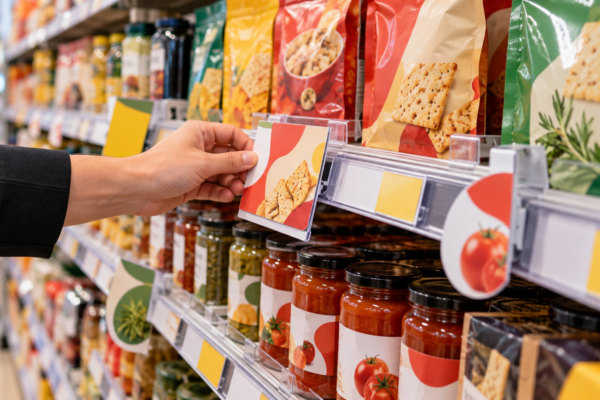
- Proper planogram compliance — products placed in the correct location with correct facings
- Display and promotional fixture setup executed on the correct date and to brand specification
- Pricing accuracy and label integrity at the point of purchase
Critical gap: Research by Retail Systems Research (RSR) consistently
shows that a significant percentage of out-of-stocks are not caused by stockouts at the
DC level — they are caused by product sitting in the backroom while the shelf location
reads empty. The supply chain delivered the product; the last step of in-store execution
failed to complete it.
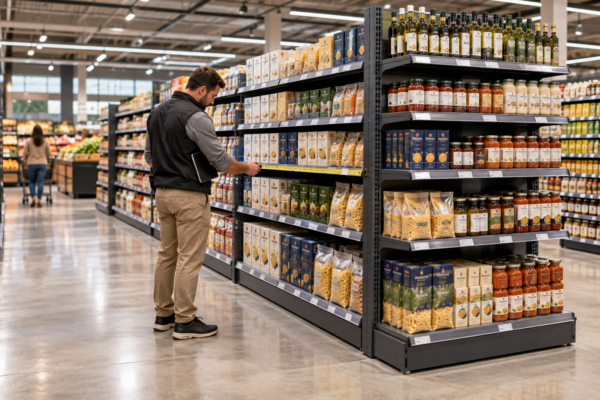
In-Store Execution: The Final Link in the Retail Supply Chain
The entire upstream investment in sourcing, manufacturing, warehousing, and retail logistics
is fully realized only when a product is correctly positioned on the shelf at the moment a
shopper reaches for it. In-store execution — the physical act of ensuring product is stocked,
shelved, signed, and displayed according to brand and retailer standards — is the final link
in the retail supply chain.
This final link is also where the chain is most frequently broken. Planogram compliance
rates across major retailers typically range from 60% to 80%, meaning that between one in
five and two in five shelf positions are not correctly executed at any given time. The
revenue leakage from non-compliance is direct and measurable: lost unit sales, lost basket
attachment, and lost brand visibility at the moment of consumer decision.
Brands operating across hundreds or thousands of retail doors cannot rely on retailer
associates alone to guarantee shelf-level execution quality. Dedicated field merchandising
programs — executed by trained, accountable field teams — close the gap between what the
supply chain delivers and what the shopper actually encounters.
For a deeper look at how shelf execution connects to broader store performance, see our
definition of what is retail execution.
How T-ROC Global Completes the Retail Supply Chain
T-ROC Global — The Revenue Optimization Companies — partners with brands and retailers to
ensure that the final link in the retail supply chain does not break. Our field teams operate
across thousands of retail locations nationwide, executing the shelf-level work that transforms
supply chain investment into captured revenue.
T-ROC’s retail merchandising and field execution services address the critical gap between
product arriving at store level and product being correctly available to the shopper:
-
Planogram resets and compliance audits — Our teams execute schematic resets
and verify compliance on regular cadences, ensuring shelf sets reflect current assortment
plans and promotional priorities. -
New item cut-ins and product launches — Speed-to-shelf matters at launch.
T-ROC field teams cut in new SKUs and promotional displays on time and to specification
across distributed retail footprints. -
Inventory and stock condition reporting — Field representatives capture
real-time on-shelf availability data, backroom stock counts, and competitive observations,
feeding actionable intelligence back into supply chain planning systems. -
Display and fixture installation — In-store fixtures and promotional
displays are installed correctly and on schedule, protecting co-op and trade spend investments. -
Brand ambassador programs — At high-velocity or high-consideration
categories, T-ROC’s trained brand ambassadors provide the human presence that drives
conversion at the final moment in the supply chain journey.
The result is a closed loop: upstream supply chain systems deliver product to the store, and
T-ROC’s field execution programs ensure that product reaches the shelf in the right condition,
the right location, and at the right time to capture the sale.
To understand the operational framework that connects supply chain execution to broader store
performance metrics, explore our resource on
what is retail operations,
or learn how precise stock management supports supply chain outcomes in our guide to
what is retail inventory management.
Close the Gap in Your Retail Supply Chain
T-ROC Global provides the field execution programs that ensure your supply chain investment
reaches the shelf — and the shopper. Let’s talk about what’s breaking your chain.