


What is Consumer Behavior in Retail?
Consumer behavior in retail is the study of how individuals and groups identify needs, search for products, evaluate alternatives, make purchase decisions, and respond after a transaction. For retailers and brands, understanding this behavior is not an academic exercise — it is the operational foundation for every meaningful decision, from store layout and staffing to marketing spend and product assortment.
Definition
Consumer behavior in retail refers to the psychological, social, cultural, and personal forces that shape how shoppers discover, evaluate, and choose products or services — and how those forces can be measured, predicted, and influenced at the point of sale and throughout the customer journey.
Why Consumer Behavior Matters to Retail Brands
Retail is a zero-sum environment. A shopper who leaves your aisle without buying does not disappear — they buy from a competitor. Every gap in understanding consumer motivation is, ultimately, a gap in revenue. Yet most brands operate with incomplete data: they know what sold but not why, and they know who visited but not what they experienced.
Consumer behavior research closes those gaps. It connects sales data to human intent, revealing not just what shoppers bought but what triggered the purchase, what nearly stopped it, and what would have increased the basket size. Brands that invest in this level of insight outperform those that rely on transaction data alone because they can intervene earlier in the purchase cycle and design experiences that remove friction at every stage.
For brands selling through third-party retailers — where they do not control the physical environment — the stakes are even higher. Understanding how shoppers behave in-aisle, how store associates influence decisions, and how the competitive landscape on shelf affects conversion is the only way to defend and grow market share.
The 4 Types of Consumer Buying Behavior
Not every purchase decision follows the same cognitive path. Consumer behavior researchers, building on Assael’s foundational framework, identify four primary buying behavior types that differ by the level of involvement and the degree of perceived differentiation between brands.
| Behavior Type | Involvement Level | Brand Differentiation | Retail Example |
|---|---|---|---|
| Complex Buying Behavior | High | Significant | Consumer electronics, large appliances |
| Dissonance-Reducing Behavior | High | Limited | Floor tiles, mattresses, office furniture |
| Habitual Buying Behavior | Low | Limited | Household staples, packaged goods |
| Variety-Seeking Behavior | Low | Significant | Snack foods, beverages, cosmetics |
1. Complex Buying Behavior
Complex buying behavior occurs when the purchase carries high financial or emotional stakes and when the shopper perceives meaningful differences between competing brands. The consumer invests significant time in research, seeks peer input, reads reviews, and often requires hands-on product experience before committing. In retail, this means the in-store associate interaction, demonstration area, and product display quality are all critical conversion levers.
2. Dissonance-Reducing Buying Behavior
Dissonance-reducing behavior applies to high-involvement categories where shoppers struggle to distinguish between options. The consumer makes a decision, but anxiety about whether they chose correctly persists after purchase. Post-sale communication, warranty messaging, and service follow-up all play a role in reinforcing the buyer’s confidence and reducing the likelihood of returns or negative reviews.
3. Habitual Buying Behavior
Habitual behavior dominates low-cost, frequently purchased categories. The consumer is not brand loyal in a deep sense — they are simply creatures of habit who default to the same product because it eliminates the need to think. For brands in this category, the strategic imperative is shelf position, consistent packaging recognition, and promotional disruption that makes trial easy enough to break ingrained patterns.
4. Variety-Seeking Buying Behavior
Variety-seeking behavior appears in categories where switching brands is low risk and novelty is inherently rewarding. The consumer switches not because of dissatisfaction but because the act of trying something new is itself the value. Brands in these categories must balance holding existing buyers through loyalty mechanics while simultaneously capturing experimenters with visible new SKUs and sampling programs.
Factors That Influence Consumer Behavior in Retail
Consumer decision-making does not occur in a vacuum. Four broad categories of forces shape how shoppers move through the purchase process, and each has distinct implications for retail strategy.
Psychological Factors
Motivation, perception, learning, and attitude formation all operate below the surface of conscious decision-making. A shopper’s perception of a brand’s quality can be shaped as much by the way a product is displayed as by its actual specifications. Retail environments that align physical presentation with the brand’s perceived status tend to command premium pricing power regardless of category.
Social Factors
Reference groups, family roles, and social media influence all affect what consumers consider acceptable to buy and from whom. Word-of-mouth recommendations — whether delivered in person by a trusted peer or algorithmically amplified across social platforms — are among the highest-conversion drivers in retail. Brands that can activate genuine advocacy at the point of sale, through well-trained brand ambassadors and positive associate interactions, capture this dynamic in real time.
Cultural Factors
Culture shapes values, norms, and consumption priorities at a macro level, while subcultures and social class layer in additional nuance. For national retail brands, this means that a single planogram or associate training script is unlikely to perform equally in all markets. Localization of retail execution — adapting messaging, product selection, and service behavior to cultural expectations — materially affects conversion.
Personal Factors
Age, income, occupation, lifestyle, and personality all create shopper segments with distinct needs. A first-time technology buyer making a smartphone purchase requires a fundamentally different in-store experience than a tech-savvy repeat buyer upgrading to a new device. Brands that develop detailed buyer personas and translate them into differentiated retail execution outperform those that treat all shoppers as interchangeable.
The Path to Purchase in Retail
The path to purchase maps the cognitive and behavioral journey a consumer travels from initial awareness to post-purchase loyalty. For retail brands, each stage presents a distinct opportunity to influence behavior — and a distinct risk of losing the consumer to a competitor.
How Brands Use Consumer Behavior Insights
Consumer behavior data is only valuable when it drives action. Brands that extract the most competitive advantage from behavioral research do so by translating insights directly into operational changes — in the store environment, in staff training, in product positioning, and in marketing investment allocation.
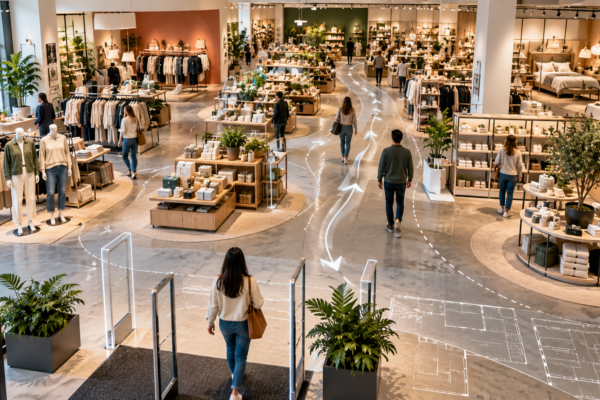
Optimizing store layout and planograms: Eye-tracking studies and shopper flow analysis reveal how consumers navigate a retail environment, which areas receive the most dwell time, and which product placements drive incremental purchase. Brands use this data to negotiate shelf position, redesign displays, and place high-margin products in high-traffic zones.
Informing associate training: If behavioral data shows that the majority of purchase decisions in a category happen within the first 90 seconds of a product interaction, training programs should prioritize rapid, confident product communication. If data shows that shoppers frequently leave without purchasing because they could not find an associate, staffing models need adjustment. Behavioral insight makes training investments specific and measurable rather than generic.
Personalizing marketing and promotions: Behavioral segmentation allows brands to serve different messages to different buyer types. A complex buyer researching a high-ticket item needs technical depth and comparison content. A habitual buyer of a commodity product needs a timely promotional trigger. Matching message to behavioral profile substantially improves conversion efficiency.
Tracking competitive performance: Consumer behavior insights extend beyond a brand’s own customers. Mystery shopping programs, competitive analysis, and third-party retail audits provide behavioral data on how shoppers interact with competitive products — revealing gaps and opportunities that would not appear in a brand’s own sales data.
How T-ROC Helps Brands Understand and Influence Shopper Behavior
T-ROC Global operates at the intersection of consumer behavior research and retail execution. The company provides the people, programs, and analytics that translate behavioral insight into measurable outcomes at the point of sale.
Mystery Shopping Programs
T-ROC’s mystery shopping services provide brands with an objective, first-person account of the consumer experience at retail. Trained evaluators move through the purchase journey as real shoppers, documenting how store associates engage with customers, how products are displayed and maintained, and where friction in the buying process exists. This produces the behavioral data that internal metrics cannot capture — not just whether a product sold, but what the experience of trying to buy it actually felt like.
Mystery shopping is particularly valuable for complex buying behavior categories, where the associate interaction is the single greatest determinant of conversion. If a brand’s mystery shopping audits consistently reveal that associates cannot confidently answer specific product questions, that is a training gap with a quantifiable revenue impact.
Brand Ambassador Programs
T-ROC’s brand ambassador programs place trained, brand-dedicated sales specialists inside retail partner locations. These associates do not simply staff a section of the store — they actively apply consumer behavior principles to every shopper interaction. They are trained to identify which buying behavior type a shopper exhibits within the first moments of an interaction, to tailor their communication style accordingly, and to address the specific psychological and social factors driving or inhibiting a purchase decision.
The data generated by these programs — conversion rates by associate, by store, by region, by product — feeds directly back into behavioral analysis and refines the execution model continuously.
Retail Analytics and Reporting
T-ROC’s analytics infrastructure connects field observations, mystery shopping outputs, sales performance data, and associate productivity metrics into a unified view of how consumer behavior is trending across a brand’s retail footprint. This enables brands to move from reactive analysis — understanding what happened last quarter — to predictive action: identifying which stores are at risk for declining conversion before the quarterly numbers confirm it, and intervening with targeted staffing, training, or merchandising corrections.
Ready to turn consumer behavior insights into retail results?
T-ROC Global helps leading brands decode shopper behavior, close execution gaps, and grow revenue at the point of sale. Talk to our team about mystery shopping, brand ambassador programs, and retail analytics.