


Complete Guide — Updated 2026
Retail Trends 2026: AI, Automation, Experience & the Forces Reshaping Commerce
What is actually changing in retail this year — and what it means for brands, operators, and field teams on the ground.
The retail industry entered 2026 in the middle of several simultaneous disruptions: AI agents are reshaping how shoppers discover and evaluate products; tariffs and commodity costs are forcing rapid repricing decisions; the mall is reinventing itself as a mixed-use destination; and the physical store is proving — again — that it is not going away.
The 2026 retail landscape rewards operators who can hold two things at once: rigorous cost efficiency and elevated customer experience. This guide maps the trends that matter most and what each one demands from brands and retail service providers.
1. The Macro Forces Driving 2026 Retail
The headline trend in 2026 is not AI. It is margin compression. Brands are managing tariff-driven input cost increases while simultaneously facing consumers who have been trained by three years of promotional activity to expect deals. Retail pricing strategy in a tariff environment has become one of the most pressing operational questions of the year — brands that raise prices bluntly lose volume; brands that absorb costs quietly lose margin.
Consumer spending trends in 2026 show a bifurcated market: high-income households are spending freely on experience and quality; middle and lower-income households are trading down aggressively. The evidence is visible in format performance: dollar stores are attracting wealthy shoppers who would have been exclusively in specialty retail three years ago. Retail operations efficiency has become the primary profit lever in this environment — not because it is new, but because the margin for operational waste has disappeared.
Real estate is also in transition. Walmart’s mall acquisition strategy reflects a broader bet that physical retail density — not e-commerce penetration — is the competitive moat for the next decade. Simultaneously, B-mall redevelopment is attracting serious investment as operators repurpose underperforming retail space into mixed-use destinations that generate foot traffic beyond traditional retail hours.
Cybersecurity has moved from IT concern to brand risk. As retail systems become more interconnected — POS integrated with inventory, loyalty platforms sharing data with e-commerce — the attack surface grows. Retail cybersecurity has become a shopper trust issue, not just a technical one. Brands that suffer a breach damage customer loyalty in ways that take years to repair.
2. AI and Automation: From Pilot to Production
AI in retail crossed a threshold in 2025: the technology stopped being a proof-of-concept and started being an operating requirement. AI is reshaping the future of retail commerce at every layer — from how shoppers discover products to how distribution centers fulfill orders.
At the infrastructure level, Walmart’s $330M distribution center automation investment set a new benchmark for what large-scale retail automation looks like operationally. The technology — robotic sorting, AI-optimized routing, automated inventory counts — is not new. The scale and integration depth is. Automated retail is revolutionizing shopping not just in distribution, but in formats like smart vending machines and cashierless stores, both of which are expanding into product categories that seemed implausible for automation just two years ago.
The real automated retail trends shaping 2026 are less dramatic than the headlines suggest: most meaningful automation is happening in back-of-house operations rather than on the customer-facing floor. Retailers automating replenishment triggers, compliance verification, and labor scheduling are generating compounding returns. The benefits and barriers of automated retail show that the primary obstacle is not technology cost — it is integration complexity and change management at the store level.
Agentic AI is the category to watch. Unlike predictive AI that surfaces recommendations, agentic AI in commerce acts autonomously — placing orders, rerouting shipments, adjusting promotions, and managing customer communications without human approval at each step. The Google-Shopify AI shopping standard from NRF 2026 signals that AI agents are entering the purchase funnel before a shopper reaches a brand’s own digital properties. Brands that have not structured their product data for AI agent consumption will be systematically filtered out of AI-mediated shopping sessions.
Emerging product categories are also driving retail technology investment. Baby tech is nurturing the next generation of retail technology — a category where considered purchases, high emotional stakes, and AI-powered recommendation accuracy are accelerating adoption of digital assistance at the shelf. Audio technology at CES 2026 showed similar dynamics: complex product comparisons that previously required a knowledgeable associate are increasingly handled by AI-assisted displays at fixture.
T-ROC’s Retail360 platform won the 2025 TWICE VIP Award for Innovation in Retail Technology — recognition of a system that bridges the AI gap between brand strategy and field execution in real time.
3. Consumer Behavior Shifts Brands Can’t Ignore
The shopper of 2026 is more informed, more skeptical, and more selective about where they spend time and attention than any prior generation of consumer. They have absorbed years of promotional noise, and they have developed sophisticated filters for authenticity. Customer loyalty in retail is now built on trust, not discounts — and that trust is earned through consistent experience, honest communication, and products that deliver on their promises.
Gen Z has fully entered the core retail consumption cohort, and their purchasing patterns are structurally different. Brand advocacy and authentic peer influence drive discovery more than paid media in this demographic. They co-create with brands they trust, amplify experiences they find genuinely interesting, and disengage with performative marketing instantly. Understanding the gap between shopper insights and consumer insights — and what each measures — is foundational for brands trying to reach these shoppers effectively.
The distinction matters operationally. Shopper insights capture behavior at the point of purchase; consumer insights capture attitudes and motivations in the broader life context. Both inform retail strategy, but they answer different questions. Brands confusing the two end up with merchandising strategies calibrated to the wrong signal.
10 retail trends that drove 2025 share one common thread: shoppers are making decisions faster and with less tolerance for friction. The queue is a conversion killer. The out-of-stock is a brand failure. The associate who cannot answer a product question is a trust deficit. Each friction point is a competitor opportunity.
Mystery shopping remains one of the most reliable diagnostic tools for understanding what shoppers actually experience — as distinct from what brands believe they experience. Mystery shoppers are here to stay in the age of tech-driven retail precisely because technology can measure what happens, but a trained shopper can capture why — the associate interaction, the display presentation, the ambient signals that determine whether a shopper feels welcomed or ignored. Mystery shoppers improve customer experience by surfacing the qualitative dimensions that transaction data cannot capture. Retail secret shopping programs remain a benchmark tool for brands running programs across multiple banners and geographies.
4. Experiential Retail and the New Store Format
The physical store that is simply a distribution point for merchandise is losing. The store that offers something a screen cannot replicate — tactile engagement, genuine expertise, curated environment, social context — is winning. This is not a new observation. The urgency is new, because the economics of pure-play e-commerce have tightened enough that even digital-native brands are racing to open physical locations.
Levi’s “Home Turf” pop-up format is the most-cited case study of 2026 for good reason. Levi’s experiential format is the blueprint for modern brands — not because it is elaborate, but because it is intentional. Every element of the store environment signals the brand’s values, invites participation, and creates a reason to stay longer than a transactional purchase requires. Experiential retail is redefining shopping across categories, not just fashion: consumer electronics demo environments, outdoor sports gear test areas, and kitchen appliance tasting events all apply the same principle.
Luxury pop-up formats are particularly interesting as a strategic tool. They generate earned media, test new markets without long-term lease commitments, and create urgency through scarcity. For brands considering the format, the operational requirements — immaculate execution, trained staff, seamless inventory management — are identical to a permanent store but compressed into a shorter window with zero margin for visible problems.
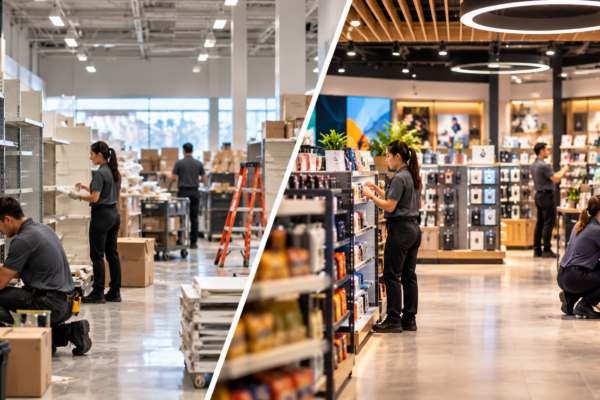
In-store assembly and display quality are the invisible enablers of experiential retail. Flawless in-store assembly that shoppers never notice is the operational baseline — the experience fails immediately when a display is broken, a fixture is misaligned, or a product is installed incorrectly. Retail merchandising trends are increasingly focused on this execution layer: the insight being that the most sophisticated store design has no value if field execution is inconsistent.
T-ROC Partners with leading brands at major industry showcases to demonstrate what excellence in retail experience looks like. T-ROC’s partnership with Hisense at CES 2025 and the broader CES 2025 showcase showed how thoughtful product presentation, trained staff, and integrated technology create demonstrations that drive retailer and consumer interest simultaneously.
5. Omnichannel, Hybrid Shopping, and Fulfillment Trends
Hybrid shopping is not a consumer preference — it is consumer behavior. Most shoppers do not think in channels. They research online when convenient, visit a store when they need to see or feel a product, buy wherever checkout is easiest, and return through whatever channel generates least friction. The omnichannel and hybrid retail models that win are the ones that remove channel seams from the customer journey entirely.
Seamless omnichannel engagement requires a common data layer — a single view of the customer, the inventory, and the transaction across all touchpoints. Without it, brands create their own friction: loyalty points that do not transfer, inventory counts that reflect online availability but not store stock, promotions that apply online but not in-store. These inconsistencies are not edge cases. They are the primary driver of cart abandonment and shopper defection at the crossover moment between channels.
The five emerging trends in virtual brand ambassadors reflect a parallel development: brands extending their in-store expertise into digital channels through AI-assisted live chat, video consultation, and voice interfaces. This is hybrid retail at its most direct — the same quality of product guidance that a trained associate delivers at shelf, now available at the shopper’s digital entry point.
Inventory accuracy is the operational prerequisite for omnichannel success. Inventory management in retail has evolved from a stock-keeping function to a customer experience driver: a BOPIS order that shows available and is not on the shelf when the customer arrives creates a negative experience worse than the channel never having shown the item as available. The best inventory systems in 2026 achieve above 97% perpetual accuracy through continuous monitoring rather than periodic auditing — making real-time channel inventory parity operationally viable for the first time.
6. Operations, Efficiency, and Field Execution Trends
The clearest operational trend of 2026 is the shift from headcount-based execution to outcome-based execution. Brands that measure their field programs by call count and hours worked are running a 2015 model in a 2026 cost environment. Brands measuring by compliance score, sales lift per visit, and corrective action close rate are compressing the gap between field activity and financial outcome.
The CES 2026 shows produced clear signals for field execution teams. CES 2026 retail execution insights documented brands deploying AI-generated visit agendas, photo-verified compliance workflows, and real-time performance dashboards from a single field rep device. Translating CES 2026 retail innovations into store results requires the same operational infrastructure — technology is the tool; trained, accountable field teams are the execution layer.
Forbes made the case for hybrid retail operations precisely: the future is not humans versus technology, it is humans empowered by technology. The brands winning on the field execution side in 2026 have invested in both — and they have built clear workflows for how each informs the other.
The broader leadership implications of these operational shifts are explored in T-ROC CEO Brett Beveridge’s work. Named one of Florida’s most influential business leaders for six consecutive years, Beveridge has been vocal about the imperative to integrate people and technology rather than choose between them. His perspective on business education and future leadership extends this view: the operators who will win the next decade are those who can manage complexity, integrate technology, and develop human talent simultaneously.
Outdoor and specialty retail is an instructive vertical. US outdoor sports industry trends show a category where high-involvement purchase decisions, strong community identity, and technical product complexity make both deep associate expertise and digital research tools essential — not either/or. The brands winning in outdoor are those who have invested in both.
The emerging technology landscape offers rich tooling for operators who know what they need. Cloud infrastructure migration within retail technology platforms is enabling the real-time data architecture that modern field operations require — eliminating the overnight batch processing cycles that previously delayed actionable insights by 12 to 24 hours.
7. What Brands Must Do Now
The macro picture can generate analysis paralysis. Here is what the trend data actually demands at the operational level.
Structure your data for AI agents
AI agents are now mediating product discovery. Product content that is incomplete, inaccurate, or unstructured will be filtered out before a shopper sees it. Audit every product attribute across every channel.
Automate the repeatable
Replenishment triggers, compliance verification, scheduling, route optimization — these should not require human decision cycles. Automate them and redeploy that capacity to judgment-intensive work.
Invest in the human moments
Complex questions, considered purchases, trust-building interactions — these are where trained human experts create ROI that automation cannot replicate. Protect that investment even as you automate around it.
Measure outcomes, not activity
Call counts and visit frequency are inputs. Compliance scores, sales lift per visit, and conversion rate differentials are outputs. Build your field program KPIs around the latter.
Close the digital-physical data loop
Field observations, store audit data, and in-store conversion metrics should be informing your digital strategy — and vice versa. Brands running parallel but disconnected digital and physical analytics are missing the most actionable signals in their business.
Build surge capacity before you need it
Holiday season and major product launches expose every gap in recruiting, training, and field infrastructure. Brands that plan their peak capacity 90 days in advance consistently outperform those building it during the rush.
The connecting thread across all of these is execution. Strategy is easy to align on. What separates retail winners from retail also-rans in 2026 is whether the strategy actually happens in-store, consistently, across every location, on every visit. That is an operations problem — and it is the problem T-ROC was built to solve.
The LATAM market also bears watching. LATAM retail trends have historically lagged North American adoption curves by 18–36 months — which means brands expanding into Latin American markets have a window to build technology and operations infrastructure before the competitive baseline hardens.
Related T-ROC Guides
Turn Retail Trends Into Execution Advantage
T-ROC helps brands translate what is happening in retail into what they need to do on the ground — through field teams, technology, and managed retail programs that deliver measurable results.