


Retail Merchandising Services:
The Complete Guide
Everything brands and retailers need to know about in-store execution — from planograms and visual merchandising to third-party outsourcing and ROI measurement.
What Is Retail Merchandising?
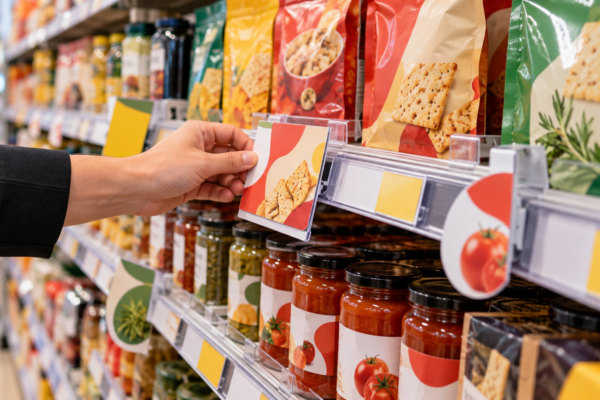
A product placed in the wrong aisle, facing backward, or obscured by a competitor’s display does not sell — regardless of the marketing spend behind it. The moment a shopper stands in front of a shelf and decides is where every upstream investment in product development, manufacturing, and advertising either converts or disappears. Retail merchandising services exist to protect that moment.
At its core, retail merchandising is the set of practices and operational programs that ensure products are correctly placed, presented, priced, and maintained inside physical stores. It sits at the intersection of brand standards and store-level reality — translating what a brand intends at headquarters into what a shopper actually encounters on the floor.
The category is broader than most people assume. For a precise definition, T-ROC’s definition of retail merchandising covers the full scope — from product selection and assortment planning to floor layout, display execution, and compliance verification. The operational side includes setting planograms, installing permanent and temporary displays, conducting store resets, repairing fixtures, rotating product, and verifying compliance across a retail network. Some programs run continuously across a full chain footprint. Others activate around a product launch, a seasonal changeover, or a retailer reset cycle.
What all of these activities share is a dependence on trained people operating inside stores, executing to a defined standard, and reporting results back to brand and retail teams. The importance of retail merchandising is not abstract — it is the margin between a 68% planogram compliance rate and a 92% one, and the difference in sell-through that gap represents.
For brands selling through mass, specialty, home improvement, grocery, drug, or electronics channels, retail merchandising services are not optional. Retailers manage thousands of SKUs across hundreds or thousands of locations. Without a dedicated execution partner, brands lose shelf position, compliance drifts, and sales underperform their potential. A comprehensive guide to merchandising services helps brands understand the full range of programs available and which ones apply to their specific channel and category.
“Roughly 70% of purchase decisions happen inside the store. Planogram compliance rates in high-volume retail environments run below 70% without active merchandising programs. The gap between those two numbers is where revenue is lost.”
T-ROC’s work goes beyond the planogram — connecting compliance execution to revenue outcomes through technology, trained field teams, and real-time reporting at scale across thousands of retail doors.
Types of Retail Merchandising Services
Not every merchandising program is the same. The service types below represent the core capabilities a brand or retailer needs to maintain strong in-store execution across a national footprint. Understanding these distinctions is essential to building a program that actually performs — and to evaluating whether a prospective partner has the capability set your specific program requires.
Planogram Compliance
A planogram defines exactly how products should be arranged on a shelf — which SKUs, in which slots, facing which direction, at which height. Compliance programs verify that stores are executing to that standard and correct deviations before they affect sales. This is the foundation of every merchandising program.
Store Resets
When a retailer reorganizes a department, changes a category layout, or introduces new SKUs at scale, a store reset program executes that change across the full chain. Resets are time-sensitive and high-stakes — a poor reset can affect an entire season of sales. Understanding the basics and breakthroughs of retail merchandising companies reveals how the most capable partners approach reset execution at scale.
Display Installation
Freestanding displays, end caps, power wings, and floor graphics all require professional installation to meet brand and retailer standards. Making an aisle end cap display that drives sales is a discipline in itself — placement, build quality, and product selection all determine conversion. Display programs typically activate around product launches, seasonal promotions, or new account wins.
Break-Fix and Maintenance
Fixtures break. Displays collapse. Signage falls. Break-fix services for retail displays dispatch trained technicians to repair or replace in-store assets on a defined response timeline — protecting both the brand presentation and the retailer relationship before the next shopper arrives.
Stocking and Product Rotation
For categories with high velocity or short shelf life — consumables, health and beauty, food and beverage — continuous stocking and rotation programs keep shelves full and product fresh. Proper merchandising inventory management is particularly important in grocery, drug, and convenience channels where out-of-stocks directly drive shopper defection.
Interactive Display Programs
In technology-forward retail environments, interactive displays require ongoing installation, maintenance, and software management. Real data from 50 stores shows how interactive retail displays can double customer engagement — but only when they are functioning, updated, and maintained to specification. Brands using interactive retail store displays to command attention need dedicated maintenance programs behind them.
Merchandising Fulfillment
Fulfillment connects the supply chain to the shelf — managing the flow of product, display materials, and point-of-sale assets from warehouse to store. Merchandising fulfillment programs are essential for brands running national promotional programs where timing precision determines the success of the campaign.
Beyond physical execution, digital merchandising has become a parallel discipline. E-commerce merchandising applies many of the same principles — product placement, assortment optimization, pricing strategy — to online retail environments. For brands that sell through both channels, consistent merchandising strategy across physical and digital touchpoints is increasingly a competitive requirement.
Visual Merchandising: The Art and Science of In-Store Presentation
Visual merchandising is the discipline of presenting products in ways that attract attention, guide the shopper journey, and drive purchase decisions. It is both an art — involving color, composition, storytelling, and brand identity — and a science, with measurable outcomes in traffic conversion, dwell time, and basket size.
For a precise definition, T-ROC’s definition of visual merchandising covers the full scope of how product presentation influences shopper behavior. The discipline encompasses window displays, store layout, product grouping, lighting, signage, and the spatial relationship between products and fixtures. When done well, a shopper moves through a retail environment with a sense of intuitive flow — finding what they need, discovering what they did not know they wanted, and spending more than they planned.
Unlocking the power of visual merchandising requires understanding the strategies that move shoppers from passive browsing to active consideration. This includes the use of focal points to anchor display sections, the strategic placement of high-margin or new items at eye level, the use of color blocking to create visual impact, and the curation of product groupings that encourage multi-item purchase.
The most effective brands treat visual merchandising as an art form for retail success — one that requires equal parts creative direction and operational discipline to execute consistently at scale. Retail visual merchandising and why it matters comes down to a simple truth: shoppers buy what they can see, reach, and understand. Visual merchandising controls all three variables.
For practical application, visual merchandising examples that convert browsers into buyers provide a useful benchmark — showing how top-performing brands use shelf presentation, display design, and store layout to create environments where purchase is the natural next step. What visual merchandising in retail actually means and why it matters is the foundation every brand team needs before building a program.
Key Visual Merchandising Principles
-
›
Eye level is buy level: Products placed at shopper eye height convert at a higher rate than shelf-top or bottom placement. Eye-level placement for priority SKUs is non-negotiable. -
›
Decompression zones: Shoppers need two to three feet of transition space at store entrances before they process signage or make product decisions. Placing high-priority product too close to the entrance reduces its impact. -
›
Power of three: Displays with three items — or three distinct price tiers — consistently outperform two-item and single-item presentations. The middle option typically captures the majority of sales. -
›
Cross-merchandising: Placing complementary products together — a grill beside grilling accessories, a camera beside memory cards — increases basket size without requiring shopper effort.
How merchandising relates to store layout is a critical connection — the flow of a store, its department sequencing, and its traffic patterns directly determine which products receive shopper attention and which are missed entirely. Visual merchandising that ignores store layout is working against the shopper journey rather than with it.
The retail merchandising secrets top stores use are less about magic and more about discipline: consistent standards, trained execution teams, photo verification, and fast correction when standards drift. The brands that win at visual merchandising are the ones that manage it as rigorously as any other commercial program.
Planograms and Shelf Execution
A planogram is a precise schematic showing how products should be arranged on a shelf — which SKUs, in which slots, with how many facings, at which height, and in which adjacency to other products. Planograms are created by retailers or brands based on category sales data, shopper behavior research, and commercial agreements. They represent the agreed-upon standard for how a shelf should look.
Understanding what a planogram is and why it is significant to the retail sales plan is foundational for any brand selling through physical retail. The planogram is not just a diagram — it is a revenue forecast in visual form. Every facing represents anticipated sales velocity. Every adjacency reflects a strategic decision about shopper flow and cross-sell potential.
Why planograms are so important to the retail process comes down to a single reality: when the shelf deviates from the planogram, it deviates from the sales forecast. A product with three planned facings that gets stocked at one facing — because a competitor’s product expanded or a stocking error was never corrected — will perform at a fraction of its potential. At scale, these deviations are catastrophic.
Compliance monitoring is the operational practice that closes the gap between planned and actual shelf conditions. It requires trained field personnel who know how to read a planogram, identify deviations, correct them, and document the corrected state with photo evidence. At the program level, compliance scores — the percentage of shelf positions that match the planogram standard — are a direct leading indicator of sales performance.
The ultimate guide to merchandising planning provides the framework for how brands should approach planogram development, retailer negotiation, and execution oversight as a unified commercial process — not as disconnected functions managed by separate teams.
A basic guide to the principles of retail merchandising planning offers practical grounding for brand teams building their first structured planning process. And for brands looking to optimize across a portfolio, merchandising analysis that connects planogram data to sell-through results reveals which assortment decisions are driving growth and which are holding it back.
Modern planogram management is also software-enabled. Merchandising software allows brands and retailers to create, modify, and distribute planograms digitally — while merchandising systems that integrate planogram design with field execution tracking close the loop between what was planned and what was actually executed. Why merchandising tools are essential to your business is increasingly a technology argument as much as a field operations one.
Third-Party Merchandising Services
Most brands cannot build or justify an internal national field force. Recruiting, training, managing, and retaining a workforce that spans hundreds of markets — while simultaneously building the technology infrastructure to track their work — requires capabilities that most brands do not have and should not try to develop in-house.
Third-party merchandising services unlock in-store ROI by providing established infrastructure that would take years and tens of millions of dollars to build internally. A capable partner brings:
- Established scale: Field teams already operating in the markets where you sell, with relationships inside the stores that matter — built over years of continuous program execution.
- Category expertise: Merchandisers trained in your specific category, with knowledge of the retailer’s requirements and the execution standards that drive results in your product segment.
- Technology infrastructure: Reporting platforms, compliance tracking, photo verification, and analytics that would cost millions to build internally — already in production and continuously improved.
- Flexible surge capacity: The ability to increase coverage rapidly during resets, launches, or seasonal peaks — without the fixed cost of permanent headcount or the operational overhead of managing surge hiring internally.
- Speed to market: Programs that can be deployed in weeks, not months — critical when a retailer reset window opens or a competitor gains shelf advantage that needs to be countered immediately.
The decision to use a third-party partner is not about relinquishing control. It is about getting better outcomes than an internal team could achieve at equivalent cost. A strong partner functions as an extension of the brand team — sharing data, aligning on priorities, and accountable for defined compliance and performance targets.
Winning the aisle and protecting your marketing investment in merchandising requires someone actively managing execution quality on the floor — because retailers will not do it for you, and without active management, standards drift. The question is not whether to invest in execution. It is whether that investment produces a return.
The ROI math is straightforward: if outsourced merchandising improves compliance by 15 percentage points and that improvement drives a 5% velocity increase across a $50 million retail program, the incremental revenue is $2.5 million. The cost of a best-in-class program is a fraction of that. Retail merchandising consulting can help brands model this calculation against their specific program parameters before committing to a partner relationship.
For brands looking for category-specific considerations, T-ROC’s guide to health tech merchandising in the $660 billion health tech market details how third-party execution partnerships work in one of the most demanding and fastest-growing retail verticals.
Field merchandising is the operational backbone of any third-party program. T-ROC’s definition of field merchandising clarifies exactly what field teams do, how they are deployed, and why their work is distinct from other retail service functions. Understanding this distinction is important for brands structuring their first outsourced merchandising program.
Benefits of Outsourcing Retail Merchandising
The case for outsourcing retail merchandising is not primarily about cost — although the economics are compelling. It is about capability. The brands that execute best at the shelf are rarely the ones with the largest internal teams. They are the ones that have partnered with organizations that do nothing but this work, at national scale, with technology built specifically for the purpose.
Consistent National Execution
A national partner brings standardized training, consistent reporting systems, and defined SLAs across every market — eliminating the regional quality variation that degrades compliance scores in internally managed programs.
Real-Time Visibility
Technology-enabled partners provide GPS-verified check-ins, photo-documented task completion, and compliance dashboards that give brand teams visibility into execution status without waiting for a weekly report that is already stale.
Faster Issue Resolution
When a display is down or a shelf is out of compliance, same-day exception management and rapid break-fix dispatch means the issue is resolved before the next day’s shopper traffic — not in the next weekly review cycle.
Proven Category Expertise
A partner with deep experience in your category brings knowledge of retailer-specific requirements, category reset cadences, and execution standards that take years to develop internally — and that are critical to performing at the highest level.
Retailer Relationship Leverage
Established merchandising partners have existing relationships with store management and category directors across major chains — relationships that translate into better floor access, more cooperative reset execution, and priority treatment during peak periods.
Scalable Without Structural Cost
Outsourced programs can surge for a national reset, a holiday peak, or a new retailer launch without the fixed cost and organizational overhead of permanently expanding an internal headcount. This flexibility is a structural advantage that compounds over time.
The future of retail merchandising trends points clearly toward technology-enabled outsourcing as the standard model for national brands — with AI-powered resource allocation, real-time compliance scoring, and integration between field execution data and point-of-sale systems becoming baseline expectations rather than differentiators.
Retail Merchandising Strategy: From Compliance to Revenue
Compliance is the floor, not the ceiling. A shelf that meets planogram standards is executing at the minimum acceptable level. The brands that extract maximum value from their retail footprint treat merchandising as a strategic commercial function — one that connects execution data to business decisions in near real time.
A complete retail merchandising strategy how-to guide covers the full arc from category analysis and planogram design through field execution and performance measurement. The core framework moves through four stages: analyze, plan, execute, and optimize.
Segment Stores by Revenue Opportunity
Not all doors are equal. High-volume stores with strong category velocity deserve more frequent coverage, higher execution standards, and faster break-fix response. A strategic program allocates field resources according to where the revenue opportunity is largest — not simply where contract minimums require coverage. A beginner’s guide to merchandise planning provides the analytical foundation for this segmentation — helping brand teams understand how to match execution investment to revenue potential at the store cluster level.
Use Data to Predict Execution Risk
Historical compliance data, sales velocity patterns, and store operational signals can identify which locations are likely to drift before they actually do. Predictive deployment gets field resources to the right stores at the right time — before out-of-stocks or compliance failures affect sales. Merchandising analysis that reveals the secrets behind successful retail strategies is the data capability that makes this predictive approach possible.
Connect Execution to Sell-Through
The strongest programs close the loop between field activity and point-of-sale data. When a store reset is completed, does velocity increase? When compliance drops below threshold, does sell-through decline? Answering these questions with data requires integrating merchandising activity reporting with retail sales data — and that integration separates execution partners from tactical vendors.
Win at the Shelf with Product Placement
Placement is more than compliance. The five product merchandising secrets that turn browsers into buyers cover the tactical decisions — adjacency, visual hierarchy, facing count, signage integration — that determine whether a correctly placed product actually converts. Even a fully compliant shelf underperforms if the strategic placement decisions behind the planogram are wrong.
How to Measure Retail Merchandising Results
Merchandising programs that cannot prove ROI get cut. Programs that measure the right metrics consistently earn budget increases. The measurement framework below covers the three tiers of metrics that matter — from direct revenue impact to operational leading indicators to brand health signals.
Tier 1: Revenue Metrics (Primary)
| Metric | Definition | Why It Matters |
|---|---|---|
| Velocity Lift | Units sold per store per week before vs. after execution program | The most direct measure of merchandising impact on revenue |
| Out-of-Stock Rate | % of store visits where product is unavailable on shelf | Each out-of-stock event is a lost sale; reduction is direct revenue recovery |
| Display ROI | Revenue lift at display-equipped locations vs. control stores | Justifies display investment and informs future placement decisions |
| Reset Compliance Value | Revenue difference between high-compliance and low-compliance reset locations | Quantifies the dollar cost of incomplete or inaccurate resets |
Tier 2: Operational Metrics (Leading Indicators)
-
✓
Planogram compliance rate: Percentage of shelf positions that match planogram specifications, measured at the store and chain level. The leading indicator for velocity performance — compliance rates above 90% consistently correlate with sell-through at or above plan. -
✓
Reset completion rate: Percentage of stores completing resets within the defined execution window. Late completions mean days or weeks of incorrect shelf conditions during the highest-stakes period of the planogram cycle. -
✓
Break-fix resolution time: Average time from defect identification to corrected execution. Resolution times under 24 hours represent best-in-class performance; anything over 72 hours represents meaningful revenue risk in high-traffic locations. -
✓
Coverage adherence: Percentage of scheduled store visits completed. A field program operating at 85% schedule adherence is effectively providing 15% less execution than planned — a gap that compounds directly into compliance performance.
Tier 3: Brand and Retailer Health
Retailer satisfaction scores, measured quarterly through structured feedback from store managers, provide an early warning system for relationship deterioration before it affects program access or placement quality. Mystery shop compliance scores — independent third-party verification of your ambassador or field team performance — provide an unbiased view of program quality that internal management data consistently overstates.
Connecting all three tiers requires a technology platform capable of aggregating field activity data, compliance scores, and sell-through results into a single performance view. This is where program-level ROI becomes measurable — and defensible in the next budget cycle.
T-ROC’s Approach to Retail Merchandising Services
T-ROC has operated at the intersection of retail execution and technology for decades. What differentiates T-ROC from conventional merchandising companies is not simply the scale of field operations — it is the integration of proprietary technology, category-specific expertise, and a management model built around measurable commercial outcomes.
Retail360: Real-Time Execution Intelligence
Every T-ROC merchandising program is powered by Retail360 — T-ROC’s proprietary execution platform. Retail360 provides GPS-verified field check-ins, photo-documented task completion with automated brand-standard review, real-time compliance scoring, and customizable dashboards for brand, category, and market-level visibility. The platform integrates with point-of-sale and syndicated data systems, enabling the revenue correlation analysis that transforms compliance reporting into commercial strategy.
Retail360 is not a reporting tool layered on top of field operations. It is built into how T-ROC executes — the system through which every work order is assigned, every store visit is verified, and every compliance exception is flagged and resolved. That integration is what enables same-day break-fix dispatch and the kind of execution precision that moves compliance scores from the 60s to the 90s sustainably.
National Scale with Local Execution Quality
T-ROC operates across thousands of retail doors and dozens of categories — consumer electronics, health technology, CPG, alcohol, home goods, home improvement, and specialty retail. National coverage is delivered through T-ROC’s own trained and managed field teams, not through inconsistent subcontractor networks that vary in quality by market. Every merchandiser is trained to T-ROC’s standards and the brand-specific standards of each program they execute.
Outcome Accountability
T-ROC measures its performance not by hours deployed or stores visited, but by compliance scores, velocity improvements, and the measurable revenue impact of execution programs. This outcome orientation is embedded in how T-ROC designs programs, reports results, and structures its partner relationships. When compliance improves, sell-through improves. When sell-through improves, the program earns its place in the commercial budget. That is the standard T-ROC holds itself to.
Ready to raise your in-store execution standard?
Contact T-ROC today to discuss your retail merchandising program requirements and learn what best-in-class execution looks like for your category and channel.
Additional Retail Merchandising Resources
T-ROC’s content library covers every dimension of retail merchandising — from foundational definitions to advanced execution strategy. Use the resources below to go deeper on any topic covered in this guide.
Strategy & Planning
Visual Merchandising
Execution & Operations
Planograms & Displays
Technology & Tools
Every dollar of retail marketing depends on what happens at the shelf.
T-ROC delivers retail merchandising services across thousands of retail doors — powered by Retail360 technology and supported by field teams trained to category-specific standards. Let’s talk about what better execution looks like for your brand.