





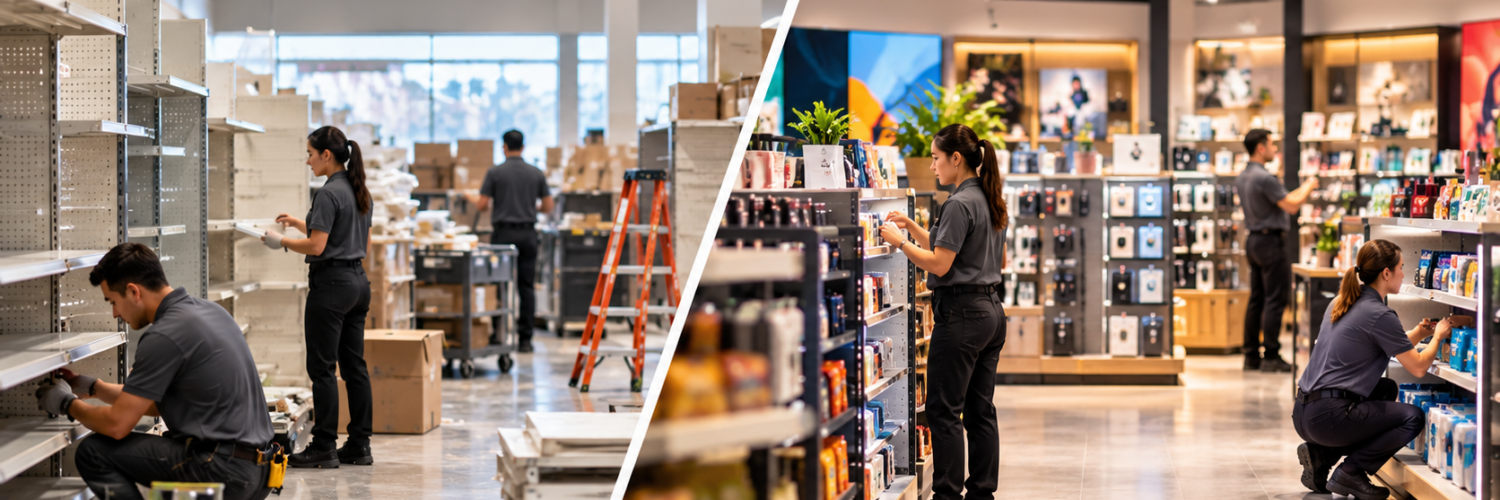
Store refreshes get scoped badly more often than almost any other retail execution project, and nearly always for the same reason: the word means different things to the brand, the retailer and the crew on the floor. One party is thinking about new graphics. Another is thinking about moving three bays. The third arrives with a van sized for the first job and a work order describing the second.
This guide defines what a store refresh covers, separates it clearly from a reset, and walks the logistics — because on a refresh, the logistics are the project.
What a store refresh is
A store refresh updates or restores the appearance and condition of a retail space without changing the underlying merchandising plan. The product stays in the same place. What changes is the material around it: graphics, signage, fixture facings, lighting elements, display units, fittings and the general condition of the space.
The purpose is usually one of three things: a brand identity has been updated and the estate needs to match it; a space has degraded and no longer presents the brand acceptably; or a season, campaign or product launch requires new visual material in place by a fixed date.
Refresh versus reset: the distinction that decides the budget
This is the single most useful thing to get straight before scoping.
A reset changes the merchandising plan. Products move, facings change, categories expand or contract, and the shelf ends up matching a new planogram. It requires plan documents, product handling, stock reconciliation and often overnight closure. Store reset services cover that work.
A refresh keeps the plan and changes the wrapper. Graphics are replaced, fixtures are cleaned or swapped like for like, signage is updated, damaged elements are repaired. Product may be lifted and replaced, but it goes back where it was.
The difference matters commercially because the two are priced on different bases. A reset is priced on plan complexity and product handling. A refresh is priced on material volume, access and travel. When a refresh brief quietly contains planogram changes — and it often does, because “while you’re in there” is how retail works — the crew has been booked and costed for the wrong job. They will either overrun or leave the planogram change undone, and both outcomes come back as a failure of execution rather than a failure of scoping.
Settle it with one question at brief stage: does the product end the night somewhere different from where it started? If yes, it is a reset.
What is in scope on a typical refresh
- Graphics and signage — header cards, shelf strips, wayfinding, window and entrance material, backlit panels.
- Fixture work — replacing damaged shelving, uprights, brackets, trim and end panels; like-for-like swaps rather than reconfiguration.
- Display units — installing or replacing permanent and semi-permanent display furniture.
- Condition and repair — cleaning, minor repairs, replacing broken or missing components that make a bay look neglected.
- Removal and disposal — taking the old material out, which is the line most often forgotten at quote stage and most often disputed at invoice stage.
- Photo documentation — before and after, per store, per bay.
Store refresh logistics
On a reset, the hard part is the plan. On a refresh, the hard part is getting material to the door. A refresh across 200 locations is a distribution exercise with an installation attached.
Kit by store, not by average
Stores are not identical. Bay counts differ, fixture generations differ, and a graphic cut for a 1.2m bay does not fit a 1.0m one. Kitting to a national average guarantees a proportion of stores receive material that does not fit, and those visits fail on arrival. Kits should be built against a per-store survey, and the survey is worth paying for.
Sequence delivery to the install calendar
Material arriving three weeks early is a back-room problem the store did not ask for, and it goes missing. Material arriving the morning after the crew has been and gone is a second visit at full cost. Deliveries should be sequenced to land inside a tight window before each booked install, with a named receiving contact at the store.
Plan the removal, not just the installation
Old graphics, broken fixtures and packaging have to leave the building. Retailers increasingly refuse to absorb the waste, and some have contractual recycling requirements. Confirm who removes what, and whether disposal is billable, before the first van moves.
Confirm access before booking the crew
Overnight access, badging, background-check requirements, lift and loading-dock availability and noise restrictions vary by banner and sometimes by store. A crew turned away at the door is a full-cost failed visit. This is the most common single cause of refresh overruns, and it is entirely preventable at planning stage.
Decide overnight versus trading hours early
Overnight work costs more per hour but avoids disruption, shrink exposure and customer-facing mess. In-hours work is cheaper and often the only option in locations without overnight access. Trading pattern, retailer policy and the nature of the material usually make this decision before budget does — so make it explicitly rather than discovering it late.
When a refresh is the right call
A refresh is the correct instrument when the plan is still working and the presentation is not. Common triggers are a brand identity update that has to roll across an estate, seasonal or campaign material with a fixed live date, visible degradation in high-traffic doors, or a retailer requirement to bring a space back to standard.
It is the wrong instrument when sales are underperforming because the assortment or the space allocation is wrong. New graphics on a bad planogram is money spent making a weak plan look tidier. That situation calls for a reset, or for the merchandising work that precedes one.
How to keep a refresh honest
- Survey before you scope. Bay counts, fixture types and dimensions, per store. Everything downstream depends on it.
- Write the exclusions, not just the inclusions. State in the brief that planogram changes, product handling and stock reconciliation are out of scope, or price them in deliberately.
- Book access before you book crews. Confirm badging, overnight permission and dock availability per store.
- Require before-and-after photos per store. Evidence is the only reliable difference between a completed refresh and a reported one.
- Track completion by door. A programme reported as 94% complete nationally may have missed an entire region; store-level completion is the only number worth reviewing.
T-ROC runs refresh and installation programmes with surveyed kitting, sequenced delivery and per-store photo reporting, using field teams already badged with the major banners. Talk to our team about what a refresh across your estate would involve.
Frequently Asked Questions
What is a store refresh?
A store refresh updates or restores the appearance and condition of a retail space without changing the underlying merchandising plan. Graphics, signage, fixture facings, display units and damaged components are replaced or repaired, while the product stays in the same location. It is typically triggered by a brand identity update, visible degradation in a high-traffic store, or seasonal and campaign material that has to be live by a fixed date.
What is the difference between a store refresh and a store reset?
A reset changes the merchandising plan: products move, facings change, and the shelf ends up matching a new planogram. A refresh keeps the plan and changes the material around it — graphics, signage, fixtures and condition. The quickest test at brief stage is whether the product ends the night somewhere different from where it started. If it does, the job is a reset and should be scoped and priced as one.
What does store refresh logistics involve?
Surveying each store so kits are built to actual bay counts and fixture dimensions rather than a national average; sequencing deliveries to land in a tight window before each booked installation; confirming access, badging and dock availability per store before crews are scheduled; and planning removal and disposal of the old material. Material that does not fit, arrives at the wrong time, or cannot be taken away is the most common cause of failed refresh visits.
Should a store refresh be done overnight or during trading hours?
Overnight work costs more per hour but avoids customer disruption, shrink exposure and visible mess, and is often required by the retailer for anything involving tools or large material. In-hours work is cheaper and may be the only option where overnight access is not granted. Retailer policy, trading pattern and the nature of the material usually settle the question before budget does, so it is worth deciding explicitly at planning stage rather than discovering it late.
How do you stop a store refresh from turning into a reset?
Write the exclusions into the brief, not just the inclusions. State that planogram changes, product handling and stock reconciliation are out of scope, or price them in deliberately as a combined refresh-and-reset. Scope creep on refreshes is usually informal — a request added on site because the crew is already in the building — so the work order the crew carries needs to be explicit about what they are not authorised to do.
How is a store refresh programme measured?
By store-level completion with before-and-after photographic evidence for each location and bay, not by a national completion percentage. A programme reported as 94% complete can have missed an entire region or a whole fixture type. Photo evidence is also the only reliable way to distinguish a refresh that was installed to standard from one that was signed off without being inspected.