


Retail is sending mixed signals right now.
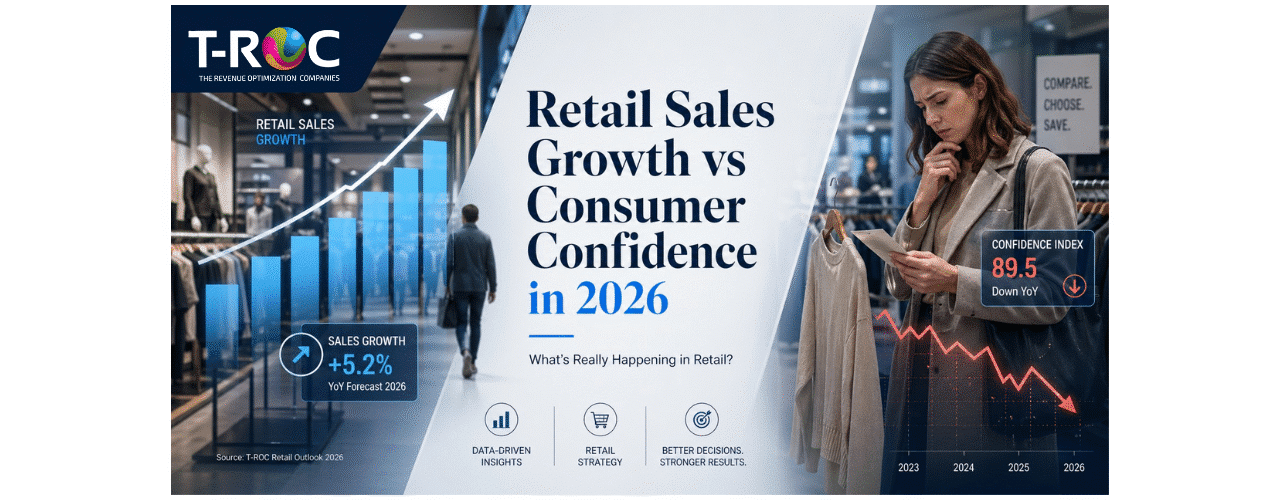
Consumer confidence is down.
Economic pressure is rising.
Yet retail sales continue to grow.
That contradiction is shaping how brands need to think about performance moving forward.
Retail Sales Growth vs Consumer Confidence
Retailers closed the first quarter with strong results.
Sales increased more than 8% in March, following steady gains in the months before.
On the surface, that looks like momentum.
But consumer sentiment tells a different story.
Confidence has dropped as inflation rises and global uncertainty continues to impact spending behavior.
That gap—between how consumers feel and how they spend—is where the real insight is.
Why Spending Hasn’t Slowed Down Yet
Not all consumers are reacting the same way.
Higher-income households are driving much of the current spending.
At the same time, many lower-income consumers are pulling back.
This creates a situation where overall retail looks strong—but underlying behavior is shifting.
Consumers are becoming more selective.
They’re:
- Trading down to lower-priced options
- Prioritizing essentials
- Cutting non-essential purchases
Value is becoming the deciding factor.
What’s Propping Up Retail Right Now
There are also short-term factors influencing performance.
Tax refunds increased significantly this year, adding more liquidity into the market.
Seasonal timing—like earlier holiday spending—also contributed.
At the same time, inflation is masking true demand.
Higher prices can make sales look stronger, even if fewer units are sold.
So while the numbers are positive, they don’t tell the full story.
The Risk Beneath the Surface
Retail performance looks stable—but the environment is changing.
Costs for essentials like housing, food, and fuel continue to rise.
Economic forecasts suggest consumer growth will slow in the coming months.
Even higher-income shoppers may adjust behavior if conditions shift.
This creates a fragile balance.
Retailers are operating in a space where:
- Demand appears strong
- Confidence is weakening
- Long-term stability is uncertain
What This Means for Retail Teams
In this environment, execution matters more than ever.
When consumers are more selective, small gaps have a bigger impact.
It’s no longer just about driving traffic.
It’s about delivering consistently when customers show up.
That includes:
- Product availability
- Operational uptime
- Consistent in-store experience
- Fast issue resolution
Why Execution Is Becoming the Differentiator
Growth alone isn’t enough.
Performance at each location matters more.
Brands need visibility into what’s happening on the ground:
- Are locations operating as expected?
- Are products available when customers arrive?
- Are issues being resolved quickly?
Without that clarity, performance becomes harder to sustain.
The Bottom Line
Retail sales are still growing.
But the conditions behind that growth are shifting.
Confidence is down.
Costs are up.
Consumers are more selective.
That combination creates both risk and opportunity.
The brands that stay close to execution—what’s happening day to day—will be better positioned to adapt.
Because right now, success isn’t about momentum.
It’s about consistency.
Frequently Asked Questions
Why are retail sales rising while consumer confidence is falling?
The March 2026 retail increase of over 8% coexists with falling confidence because rising inflation and global uncertainty have reduced sentiment. Larger tax refunds and seasonal shifts are propping up dollar sales, and inflation can inflate values even if unit volumes aren’t growing, creating a temporary divergence between dollars and underlying demand.
Which consumers are driving the current sales growth?
Growth is being driven primarily by higher-income households that continue to spend, while lower-income consumers are 'trading down' toward lower-priced options and essentials. This bifurcation means aggregate dollar sales can rise even as significant segments reduce discretionary purchases and shift toward value-oriented behavior.
Are current sales figures a reliable signal of future demand?
Current sales can be misleading because they are partially supported by larger tax refunds and seasonal effects, and inflation can raise dollar amounts without increasing unit volumes. Because consumer confidence typically leads actual spending by one to two quarters, falling sentiment signals a possible pullback in volume ahead.
What operational areas should retailers prioritize when consumers are more selective?
Retailers should prioritize operational execution, including product availability, store uptime, and consistent customer experiences, since execution becomes the primary differentiator when consumers are selective. Maintaining visibility into ground-level performance helps identify issues quickly and supports reliable delivery that preserves loyalty amid uncertain demand.
How can retailers test new strategies before full rollout?
Retailers can use structured pilots, such as 30-day smart vending trials, to validate strategies before scaling. Short, measurable pilots provide ground-level data on availability and customer response, enabling decisions based on current sentiment and performance rather than relying only on past sales momentum.
Want to Go Deeper?
If you’re evaluating how to improve performance across locations—or testing new retail formats—there’s a smarter way to approach it.
👉 Explore how a structured pilot can help validate performance before scaling:
https://trocglobal.com/Smart-Vending-30-Day-Pilot/