







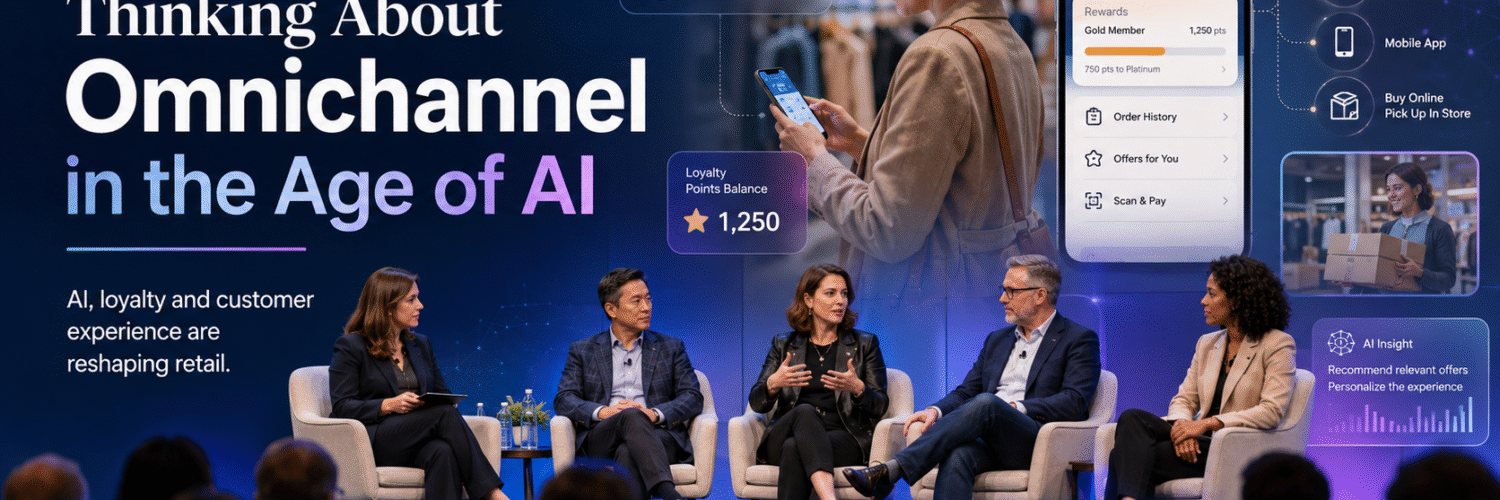
Artificial intelligence has given retailers powerful new ways to drive traffic, personalize recommendations, and manage loyalty programs. But as a panel of senior retail executives made clear at the CommerceNext Growth Show in New York this week, the technology is a means to an end — not the end itself. Retail, they argued, is still fundamentally about emotional connection.
The discussion, reported by Lara Ewen for Retail Dive following the June 24, 2026 panel “From Digital Natives to Legacy Institutions: Omnichannel’s Next Era,” brought together leaders from Ulta Beauty, Stitch Fix, Tapestry, Boot Barn, and the marketing-technology firm Novi. Their consensus offers a useful reality check for any brand racing to bolt AI onto its customer experience.
Omnichannel Now Includes the Algorithm
The definition of “omnichannel” has expanded well beyond in-store and online. Today it includes AI assistants and agentic platforms that increasingly sit between the shopper and the brand.
“Most consumers are shifting discovery to agents, agentic platforms, ChatGPT, Gemini,” said Kimberly Shenk, CEO of Novi. As that shift accelerates, she noted, a brand’s identity has to remain consistent across every touchpoint — because the brand no longer fully controls where the first impression happens.
That has a direct consequence for how products get found. According to Shenk, AI tools don’t simply repeat what a shopper types. “[AI] doesn’t actually take the user prompt and use that verbatim. It takes a user prompt and then triggers its own set of thousands of queries.” In other words, large language models do their own research — fanning a single question out into many — before surfacing an answer.
And critically, those answers are framed around solutions, not brands. “AI recommends products as a solution to a problem that a consumer is asking,” Shenk said. “It’s not recommending a brand name.” For retailers, the takeaway is clear: you have to earn your place inside the AI’s reasoning, not just inside the search results page.
Loyalty Is the Most Durable Connective Tissue
If AI is reshaping discovery, loyalty is what keeps customers coming back — and it remains stubbornly human.
Shenk pointed out that AI-driven discovery often doesn’t end in an immediate click, partly because shoppers want to return to the programs they already value. At Ulta Beauty, that pull is enormous. Josh Friedman, senior vice president of e-commerce and digital, said the retailer has 47 million loyalty members and that 95% of sales flow through the loyalty program. Connecting that data to AI, he said, helped Ulta “develop better algorithms, generate some better content, and more content,” and its recently launched Ulta AI has tied the experience together across channels.
Boot Barn is leaning on the same playbook. Chief Digital Officer Jon Kosoff, who moderated the panel, noted that 30% of the chain’s orders are picked up in store and 40% ship from stores — but across every channel, loyalty is the thread that holds the experience together. The company relaunched its app in April alongside a new tier-based loyalty program.
At Stitch Fix, roughly 60% of clients have downloaded and regularly use the app, said Chief Marketing Officer Debbie Woloshin. Yet she reframed loyalty entirely: “We’re basically in the relationship business.” Because clients share deeply personal information — sometimes telling Stitch Fix they’re pregnant before almost anyone else — the company pairs technology with human stylists to deepen personalization “beyond just sort of a rewards feature.”
Start With the Customer, Not the Technology
Perhaps the sharpest guidance came from Tapestry’s Mandeep Bhatia, senior vice president of global digital product and omnichannel innovation. He described how agentic AI finally makes it possible to scale the kind of store-concierge experience that was previously impossible to replicate online.
But Tapestry didn’t begin with the model. It began with its people. “We talked to hundreds of store associates and said, ‘What do the customers ask when they come to stores? How do they talk to you?'” Bhatia said. Those real conversations became the training data, producing a digital experience that feels unmistakably on-brand.
His warning to the industry was blunt: “Don’t start with technology first. Just because AI is there doesn’t mean that we have to start creating those things. It has to be rooted in the understanding of customers and the understanding of associates.” Every AI initiative, he added, has to be weighed as “either painkillers, vitamins or chocolates” — and you can only tell which is which by understanding what the customer actually needs.
What This Means for Retailers
For brands sorting hype from substance, the panel points to a few durable principles:
- Optimize for AI discovery, not just search. If LLMs fan a single question into thousands of queries and recommend solutions over brand names, your content and product data need to clearly answer the underlying problem — not just rank for a keyword.
- Keep brand identity consistent everywhere. When the first touchpoint might be ChatGPT, an app, or a store shelf, inconsistency erodes trust before a shopper ever reaches you.
- Treat loyalty as relationship, not points. The retailers winning here use data and technology to deepen genuine connection, not to replace it.
- Mine your front line. Your store associates already know how customers talk and what they ask. That knowledge is the best foundation for any AI experience — and for the in-store execution that turns digital intent into a sale.
That last point is where the digital and physical worlds meet. AI can route a shopper to the right store and surface the right product, but the moment of truth still happens on the floor — with a knowledgeable associate, a well-stocked shelf, and an experience that matches the brand promise. The retailers thinking most clearly about AI aren’t replacing that human layer. They’re using technology to make it scale.
Source: Lara Ewen, “How retailers are thinking about omnichannel in the age of AI,” reporting on the CommerceNext Growth Show panel held June 24, 2026.
Frequently Asked Questions
What does omnichannel mean in the age of AI?
Omnichannel now goes beyond physical stores and websites to include AI assistants and agentic platforms such as ChatGPT or Gemini that often sit between shoppers and brands. These systems change where discovery happens, so brands must keep a consistent identity across every touchpoint because they no longer fully control the first impression.
How does AI change product discovery and search?
Large language models and agentic platforms do not simply pass along a shopper prompt. They expand it into many queries and surface solutions rather than brand names. That means AI recommends products as answers to problems, so retailers must earn placement inside the reasoning of the model through content, signals and structured data, not just on traditional search result pages.
Why is loyalty still important when AI is reshaping discovery?
Loyalty remains the most durable connective tissue because it keeps customers returning even when discovery shifts to AI. The Ulta loyalty program, for example, drives the vast majority of sales, with 47 million members and 95% of sales flowing through the program. Loyalty provides trust and a reason for shoppers to choose a brand that AI recommends.
How should retailers integrate AI without losing emotional connection?
Start with customer needs and relationships, not the technology. Use AI to scale helpful experiences such as store-concierge service and personalized recommendations, but pair it with human elements where appropriate. Connect loyalty and first-party data to AI so personalization feels relevant and emotionally resonant rather than purely transactional.
What practical steps can brands take now to succeed in omnichannel AI-driven commerce?
Ensure a consistent brand identity across agentic platforms, structure content and product data so AI can surface your products as solutions, integrate loyalty data with AI-driven personalization, and design hybrid experiences that combine automated recommendations with human service where it matters.