




Consumer Spending Trends: What Retailers Must Know
-
 T-ROC Staff
-
 Mar 20, 2026
 -
 5 mins read
Retail leaders are looking at the same numbers — and coming to very different conclusions.
Inflation has cooled. Consumer spending hasn’t collapsed. On the surface, things look stable.
But underneath, behavior is shifting in ways that are harder to detect and even harder to respond to.
Understanding consumer spending trends retail 2026 requires looking beyond traditional reports. The real story isn’t in what shoppers say. It’s in what they actually do.
The Shift: From Big Changes to Small Adjustments
In past economic cycles, consumer behavior changed in obvious ways. Spending dropped. Categories collapsed. Signals were easy to spot.
This time, it’s different.
Consumers are making small, calculated adjustments instead of sweeping changes. They are reallocating spending across categories rather than cutting it entirely.
That means:
-
trading down in some areas
-
maintaining premium spending in others
-
shifting between channels
-
reducing how often they shop
These changes are subtle, but they add up quickly.
Premium vs. Value: A Growing Divide
One of the most important consumer spending trends in retail is the growing gap between premium and mid-market brands.
High-end brands are still performing. In some cases, they are seeing increased transaction activity. But the way customers spend has changed. Instead of one large purchase, shoppers are making multiple smaller ones.
At the same time, mid-tier retailers are losing ground. Consumers are either moving up for experiences they value or down for savings.
This “barbell effect” is becoming more pronounced.
Retailers stuck in the middle are feeling the pressure.
Trading Down Is Strategic, Not Reactive
There is a common assumption that trading down is driven by financial stress.
In reality, many consumers are making intentional choices.
Higher-income households are often the ones shifting spending between categories. They are not spending less overall. They are optimizing where their money goes.
A shopper might choose a lower-cost option for household goods while continuing to spend on dining or premium experiences.
Understanding this behavior is critical.
Retailers that treat all trading down as price sensitivity risk misreading their customers.
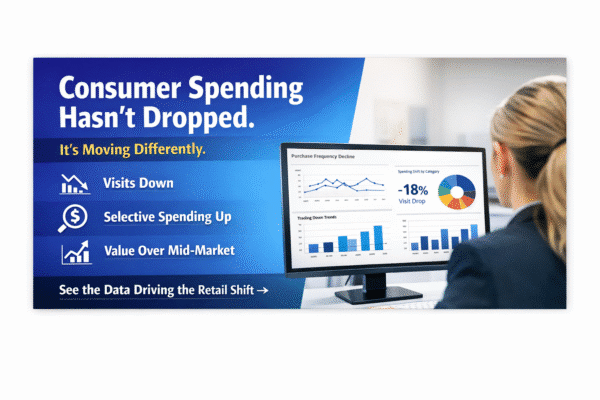
Fewer Visits, Same Spending
One of the most actionable insights in current consumer spending trends is the decline in shopping frequency.
Consumers are not necessarily spending less per visit. They are simply showing up less often.
Casual dining is a clear example. Visit frequency is down, but average ticket size remains stable.
This pattern is appearing across multiple retail categories.
It has a direct impact on revenue.
Fewer visits mean fewer opportunities to sell.
Why Traditional Data Falls Short
Most retailers rely on surveys, loyalty data, or quarterly reports to understand customer behavior.
The problem is timing.
By the time these signals appear, the behavior has already changed.
Transaction data provides a different perspective. It captures real-time spending patterns across categories and channels.
This allows retailers to identify shifts earlier and adjust faster.
How Retailers Should Respond
The most effective retailers are not reacting to headlines. They are responding to behavior.
Focus on Core Customers
Brands that understand who their customers are — and how they are changing — perform better in uncertain conditions.
Trying to appeal to everyone creates confusion. Clarity creates loyalty.
Align Strategy With Behavior
Both value-focused and premium strategies can succeed.
What matters is consistency.
Some brands are leaning into affordability and gaining share. Others are reinforcing premium positioning and doing the same.
The difference is alignment with their customer base.
Improve Store-Level Execution
As shopping frequency declines, each visit matters more.
Retailers must ensure that pricing, promotions, and product presentation are executed correctly across all locations.
Retail execution visibility tools help brands confirm what is happening in stores in real time, reducing missed opportunities and improving consistency.
Strengthen In-Store Engagement
When customers visit less often, the in-store experience becomes more important.
Well-trained associates can help guide decisions, explain product value, and increase conversion.
Assisted sales programs show how human interaction can improve outcomes, especially when customers are more selective about when and where they shop.
The Bigger Picture: A Reorganized Consumer Economy
The consumer economy is not shrinking.
It is reorganizing.
Spending is still happening, but it is moving differently across categories, channels, and customer segments.
Retailers who wait for traditional indicators will always be behind.
Those who act on early signals gain an advantage.
Final Thoughts
Consumer behavior is not always loud.
Right now, it’s quiet. Subtle. Easy to miss.
But the impact is significant.
Retailers who understand these shifts — and adjust early — will be in a stronger position to compete.
The question is not whether consumers are spending.
It’s whether you understand how they’ve changed.
T-ROC Editorial Team
The T-ROC editorial team brings 20+ years of retail industry expertise across brand ambassador programs, mystery shopping, retail merchandising, and managed technology solutions. Learn more about T-ROC.