



What Is Retail Staffing? Definition, Models, and How It Works | T-ROC Global
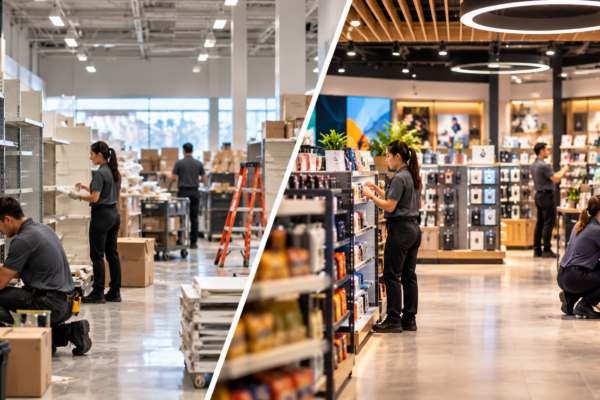
Retail staffing is the discipline of providing trained workers to retail field operations — including brand ambassador deployment, merchandising labor, mystery shoppers, reset crews, product assembly workers, and on-demand surge capacity for peak retail moments. Retail staffing operates as the workforce infrastructure underlying every retail services category, with specialization requirements that vary substantially by use case.
This page covers the working definition, the major retail staffing categories, common staffing models, and the criteria distinguishing institutional-grade retail staffing from generic labor delivery.
What Retail Staffing Actually Covers
Retail staffing spans multiple distinct worker categories:
- Brand ambassador staff — customer-facing representatives at retail locations
- Merchandising staff — field reps executing planogram compliance and category execution
- Mystery shoppers — covert evaluators conducting customer experience assessments
- Reset crews — specialized crews handling category reset and fixture installation
- Product assembly workers — in-store or in-home assembly services (grills, patio furniture, fitness equipment)
- Sampling staff — product trial generation at grocery, mass, and club channels
- Event activation staff — trade shows, sponsorship events, brand activations
- On-demand surge capacity — rapid-deployment workers for peak season or unexpected operational needs
Why Retail Staffing Operates as a Specialized Category
Retail staffing isn’t fungible across these categories. A trained wireless retail brand ambassador requires technical product certification that takes weeks to develop. A beauty advisor requires consultation skills and product application expertise. A reset crew member requires fixture installation and planogram execution capability. The talent pools are operationally distinct.
Strong retail staffing providers maintain specialized talent pools across multiple categories simultaneously, with branded training, certification, and ongoing reinforcement specific to each category’s operational requirements.
Common Retail Staffing Models
W-2 Employee Staffing
Workers classified as W-2 employees of the staffing provider, with benefits eligibility, payroll tax withholding, and workers’ compensation coverage. Common for sustained programs and specialized roles requiring training investment.
1099 Independent Contractor Staffing
Workers classified as 1099 independent contractors. More common in mystery shopping and specific gig-style retail roles where worker autonomy is appropriate. Subject to evolving regulatory requirements around classification.
Hybrid Models
Many retail staffing providers operate both W-2 and 1099 capability, selecting the appropriate model per program based on regulatory requirements, role characteristics, and client preference.
What Distinguishes Institutional Retail Staffing
Strong retail staffing providers operate with infrastructure that generic staffing agencies typically lack:
- Specialized talent pools — maintained category-specialized worker rosters rather than per-program recruiting
- Branded training and certification — documented training programs with paid training time and certification before deployment
- Multi-state HR compliance infrastructure — established labor law, payroll, and workers’ compensation capability across states
- Field management technology — software platforms for scheduling, GPS check-in, photo verification, and real-time visibility
- Performance accountability infrastructure — KPI tracking, quality assurance, and ongoing performance review
- Hiring and onboarding discipline — pre-vetted worker pools with background checks and validation
How Retail Staffing Connects to Other Retail Services
Retail staffing is the workforce layer underlying every retail services category. Strong retail staffing providers typically operate integrated retail services portfolios where staffing supports brand ambassador programs, merchandising programs, mystery shopping programs, reset programs, and event activations simultaneously.
The integrated structure delivers better unit economics and operational quality than fragmented staffing providers operating single-purpose deployments.
How Much Does Retail Staffing Cost
Retail staffing costs vary by category specialization:
- Brand ambassador staffing: $20-45 per hour fully loaded (see our brand ambassador staffing cost guide)
- Merchandising staffing: $35-85 per store visit (see our retail merchandising cost guide)
- On-demand surge staffing: 15-30 percent premium over scheduled programs (see our on-demand staffing cost guide)
- Field team integrated staffing: $28-50 per hour fully loaded (see our field team services cost guide)
T-ROC Global Retail Staffing
T-ROC Global operates one of the largest specialized retail staffing operations in North America — with 50,000+ pre-vetted retail workers across specialized category talent pools, established multi-state HR compliance infrastructure, proprietary field management technology (T-ROC Connect, Retail360), and branded training programs across major retail categories.
See our retail staffing services overview for the full capability framework.