




An endcap is the display at the end of a store aisle, facing the main traffic path. It is the most valuable shelf space in most retail formats, and brands pay real money to occupy it — through trade spend, promotional agreements or category negotiations.
What almost nobody checks is whether the endcap they paid for was actually built. Not designed, not authorised, not shipped: built, in that store, with those products, on the agreed date, and left standing for the full window. That gap between the endcap on the plan and the endcap in the aisle is where most of the investment leaks.
What an endcap display is
An endcap occupies the short end of a gondola run. Because it sits perpendicular to the aisle, shoppers see it while walking the perimeter rather than only when they turn into the category. That visibility is the entire value proposition: the same product, in the same store, moves at a different rate depending on whether it is on the shelf or on the cap.
Endcaps generally take one of four forms:
- Promotional endcaps tied to a price event, holiday or seasonal window.
- Brand-block endcaps where a single manufacturer holds the full display.
- Cross-merchandising endcaps that pair complementary categories — grill tools beside charcoal, batteries beside toys.
- New-item endcaps used to build trial for a launch before the item earns permanent shelf space.
Why the endcap is the most contested space in the store
Endcap inventory is finite in a way regular shelf space is not. A category can always be re-spaced to fit another SKU; a store has a fixed number of aisle ends. Every one that goes to one brand is unavailable to every other brand for the length of the window.
That scarcity is why endcap placement is negotiated rather than requested, and why the cost is rarely trivial. It is also why verification matters more here than almost anywhere else in the store: an unbuilt endcap is not a small execution miss, it is a paid placement that did not happen.
The five ways an endcap fails
It never gets built
The display ships, the instructions arrive, and the fixture stays in the backroom because the reset crew ran out of hours or the pallet was never located. The brand finds out at the end of the period, when sales did not move.
It gets built late
A four-week promotional window that starts eleven days late is not a four-week window. For seasonal products, the late portion is often the part that mattered — a Halloween cap built in mid-October has lost most of its value.
The wrong products go on it
The cap is built, but with the SKUs that happened to be in the backroom rather than the ones in the agreement. This is common with launches, where the new item is the one thing not yet in stock at store level.
Product gets borrowed
The endcap is stocked correctly on day one. By week two, staff have pulled units from it to fill gaps in the main aisle, and the display is half empty. It still looks like your endcap. It no longer performs like one.
It comes down early
The next promotion needs the space, so the cap is dismantled days before the agreed end date. Nobody records that the window was shortened, and the performance data quietly compares a partial execution against a full-period plan.
What endcap compliance actually measures
“Compliance” is only useful when it is broken into things that can be counted separately. For endcaps, four numbers cover it.
- Build rate. Of the stores authorised for the display, how many physically had it. This is the headline number and the one most programs never establish.
- On-time rate. Of the caps that were built, how many were standing on day one of the window. A display that appears on day nine counts as built and still lost most of its value.
- SKU accuracy. Whether the products on the cap match the agreement, checked item by item rather than as an overall impression.
- Duration served. Whether the display stayed up for the full window, verified at the end rather than assumed.
Tracked by store and by banner, these four turn a vague sense that “the promotion underperformed” into a specific answer: it underperformed in 140 stores because it was never built in 41 of them. That is the same measurement logic we apply to merchandising optimization more broadly.
How to verify it at scale
Endcap verification is a photo problem before it is a data problem. A field representative standing in front of the display, photographing it with a timestamp and a store identifier, settles every question the reporting cannot: was it built, when, with what, and is it still there.
Three practices make that work across a national footprint:
- Photograph at both ends of the window. One image on build day proves execution; one near the close proves duration. Programs that only capture the first miss every early teardown.
- Score against a written standard. The person in the store needs to know what correct looks like — which SKUs, how many facings, which signage. Without that, findings vary by auditor and the data cannot be compared. This is the same discipline behind any retail compliance audit.
- Fix during the visit. If the cap is half empty, restocking it there is worth more than a report saying it was half empty. A finding that waits for the next cycle carries the loss until then.
This is why endcap verification tends to ride along with existing retail audit programs rather than being commissioned separately: the visit is already happening, and the marginal cost of adding four checks is small.
Designing an endcap that earns the space
Verification tells you whether the display existed. Design decides whether it worked. A few principles hold across categories:
- One message. An endcap read from a moving shopper at three metres has room for a single idea — a price, a use case or a new product. Three ideas read as none.
- Full and faced. A partially stocked cap reads as picked over, and shoppers avoid it even when the product they want is there.
- Adjacency that makes sense. Cross-merchandising works when the pairing solves a task the shopper already had, not when it merely combines two things on promotion.
- Signage that survives. Header cards fall, get flipped or get covered. If the message depends on a single piece of cardboard, plan for it to be missing by week two.
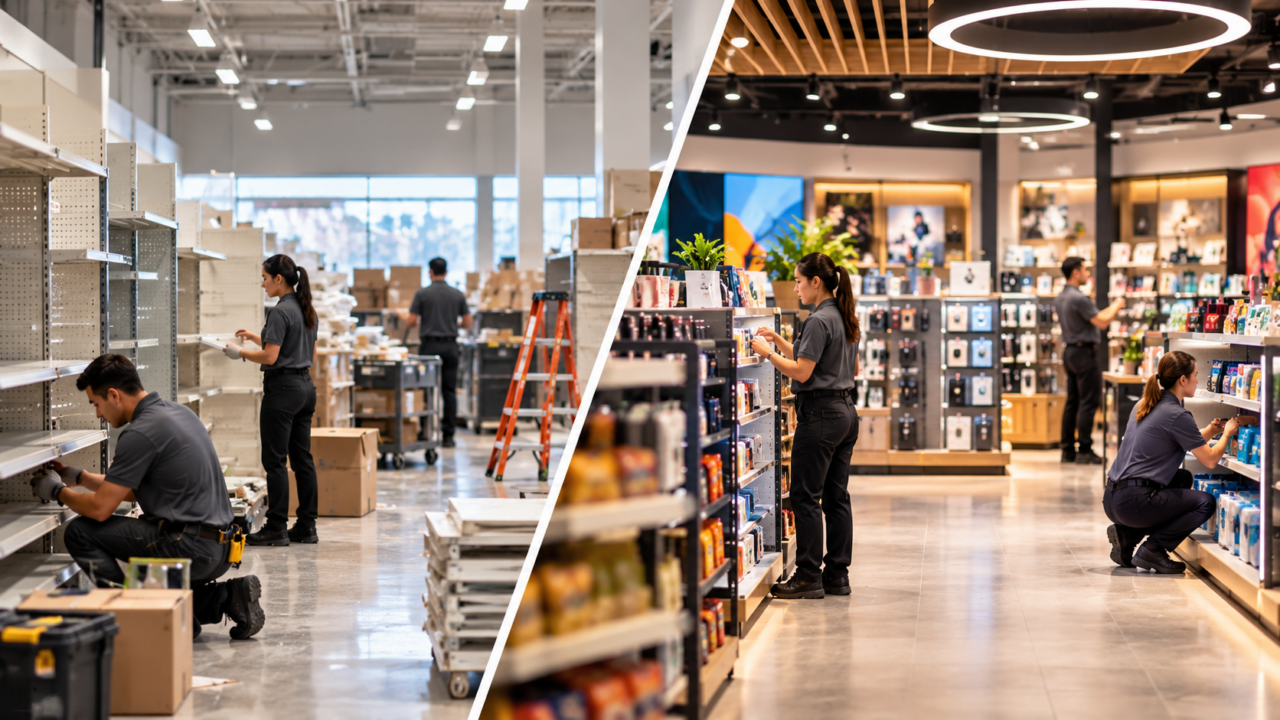
Endcaps are usually installed during a store reset, which is why reset execution quality and endcap performance are closely linked — and why both belong in the same conversation about the retail execution gap.
Frequently Asked Questions
What is an endcap display in retail?
An endcap is the display unit at the end of a store aisle, positioned perpendicular to the main traffic path. Because shoppers pass it without entering the category, it carries far more visibility than standard shelf space, which is why brands negotiate and pay for the placement.
Why are endcap displays so effective?
Two reasons. Exposure: every shopper walking the perimeter sees the cap, including those who never planned to visit that aisle. And interruption: a single, clearly presented message at the end of a run is easier to process than the same product among dozens of competitors on shelf.
How do you know whether an endcap was actually built?
Photographic verification with a timestamp and store identifier, captured at both the start and the end of the promotional window. Sales data alone cannot distinguish between a display that underperformed and one that was never installed, and store-reported completion is a claim rather than evidence.
What is a good endcap compliance rate?
The useful benchmark is your own baseline rather than an industry figure. Most brands that measure build rate for the first time find it lower than assumed. Establish the current number across a representative sample of stores, then track whether corrective work moves it, by store and by banner.
What is the difference between an endcap and a display?
Endcap refers specifically to the fixture at the end of an aisle. Display is the general term for any secondary placement, which also includes floor stands, pallet drops, clip strips and counter units. Every endcap is a display; most displays are not endcaps.