
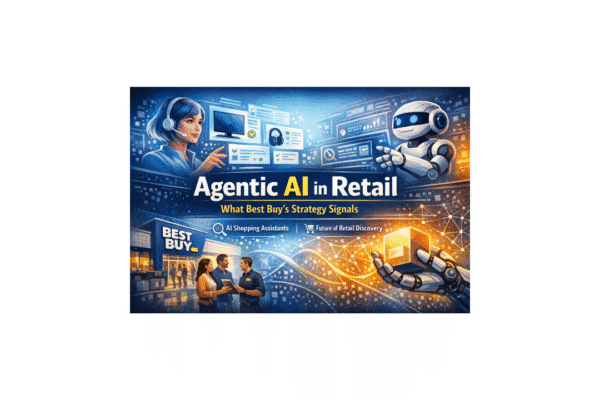




Agentic AI in Retail: What Best Buy’s Strategy Signals
-
 T-ROC Staff
-
 Mar 11, 2026
 -
 6 mins read
Retail discovery is entering a new phase. For years, the path to purchase followed a familiar pattern. Shoppers searched online, compared options across several websites, and then chose where to buy. That process is beginning to change.
Retailers are preparing for a future where artificial intelligence performs much of the discovery work on behalf of consumers. Instead of manually browsing product pages, customers may rely on AI assistants that search catalogs, compare specifications, and recommend products automatically. Best Buy recently signaled its intention to lead in this space by preparing its digital ecosystem for what many are calling agentic commerce.
By adapting its platform so AI systems can browse and interpret product data, the company is positioning itself for a future where product discovery increasingly happens through intelligent assistants rather than traditional search engines.
Understanding Agentic AI in Retail
Agentic AI refers to software that performs tasks independently on behalf of users. In a retail context, these systems function like digital shopping assistants. Rather than simply responding to a prompt, they can conduct research, compare products, evaluate pricing, and even guide purchasing decisions.
A shopper might ask an AI assistant to find the best television within a certain price range and feature set. Instead of opening multiple tabs and reading product pages, the AI system scans retailer catalogs, analyzes specifications, and presents a shortlist of options.
For consumers, this removes friction from the shopping process. For retailers, it shifts the importance from keyword optimization and website navigation to structured, machine-readable product data.
Why Best Buy Is Preparing for AI-Driven Product Discovery
Best Buy’s leadership has emphasized the importance of ensuring its product catalog is accessible to AI platforms. By working with major technology providers, the retailer is enabling AI assistants to interpret its product information and guide customers directly to relevant listings.
This requires retailers to rethink how product data is organized. Clear product names, accurate pricing, correct variant information, and real-time availability all become essential. If an AI system recommends a product and the customer lands on a page with incorrect information or unavailable inventory, trust disappears immediately.
Retailers that maintain precise and accessible product data will be far more likely to appear in AI-driven recommendations.
The Trust Moment in AI Commerce
One of the most critical elements in this emerging environment is what researchers describe as the trust moment.
The trust moment occurs when a customer moves from an AI recommendation to a retailer’s website. If the information they encounter differs from what the AI assistant presented, the entire interaction breaks down. Incorrect pricing, unavailable items, or unclear product options create doubt and interrupt the purchase journey.
Because of this, data accuracy becomes a central component of customer experience. Product catalogs must be clean, consistent, and easy for machines to interpret. Retailers that treat product data management as a strategic priority will have a significant advantage in AI-driven discovery environments.
The Strategic Risk of AI-Mediated Shopping
While AI-powered discovery increases visibility, it also introduces new challenges for retailers.
If AI assistants become the primary entry point for shopping, the assistant effectively acts as the storefront. Discovery, comparison, and evaluation may occur before a customer ever visits a retailer’s website.
This shift can weaken the direct relationship between brands and customers. Retailers may lose visibility into shopper behavior and preferences, while price comparisons become more prominent. Loyalty programs and personalized experiences also become harder to deliver when interactions occur through third-party platforms.
For retailers, the challenge is balancing reach with ownership of the customer relationship.
Why Physical Stores Still Matter
Despite the growth of digital discovery, physical retail continues to play a critical role—especially for complex products like consumer electronics.
Customers often want to see devices in action, compare features side by side, and receive guidance from knowledgeable associates. In-store expertise provides reassurance and context that AI systems alone cannot fully replicate.
Assisted sales programs remain particularly important in these situations. Trained associates help customers interpret product differences, answer questions, and recommend the right solutions based on individual needs.
Rather than replacing human interaction, AI will likely narrow the list of options before the shopper arrives in-store. From there, knowledgeable associates help customers make the final decision with confidence.
Data Visibility and Retail Execution
As technology reshapes product discovery, operational execution becomes even more important.
Retail leaders often invest heavily in strategy, promotions, and training. Yet those initiatives can fail if execution at the store level breaks down. Displays may be incomplete, product knowledge may vary between locations, or promotions may not be implemented as intended.
Solutions that provide real-time visibility into store operations help address these challenges. Platforms that track field activity, merchandising compliance, and in-store performance allow retailers to understand what is happening across locations and respond quickly when issues arise.
In an environment where AI-driven demand can shift quickly, having accurate operational insights becomes a competitive advantage.
Automation and AI Working Together
Agentic AI is only one piece of a broader transformation in retail technology. Many stores are also adopting automation tools to improve speed, accuracy, and consistency.
Examples include self-checkout systems, smart shelves that monitor inventory levels, and interactive kiosks that guide shoppers through product options. These technologies help reduce stockouts, streamline operations, and support store teams during busy periods.
When combined with AI-driven product discovery, automation creates a retail environment where digital intelligence and physical operations reinforce one another.
Preparing for the Next Phase of Retail
Although agentic commerce is still emerging, retailers can begin preparing today.
The first step is ensuring product data is clean, structured, and consistently maintained. AI systems rely on accurate data to generate recommendations, making data quality a foundational requirement.
Retailers should also invest in product knowledge training for store associates. While AI can narrow down options, human expertise remains essential for explaining features, comparing alternatives, and helping customers feel confident in their purchase decisions.
Operational visibility is another priority. Retailers need tools that provide real-time insight into merchandising, training, and store execution across their locations. Finally, strong fulfillment capabilities—such as fast delivery and convenient pickup options—remain crucial for meeting customer expectations.
A New Discovery Layer in Commerce
Retail has already experienced several major shifts in how customers discover products. Search engines changed how shoppers began their research. Mobile devices transformed how people browse and buy.
Agentic AI introduces another change. The search itself may increasingly be performed by intelligent assistants acting on behalf of customers.
Retailers that adapt early will remain visible in this new discovery layer. Those that fail to prepare risk becoming less visible as AI systems guide shoppers toward competitors with better data, availability, and experiences.
Best Buy’s strategy highlights how major retailers are responding. By preparing their platforms for AI discovery while continuing to invest in store experiences and human expertise, they are building a retail model designed for the next era of commerce.