





AI does not fix messy operations. It exposes them.
For retailers, kiosk operators, smart vending companies, and consumer brands, this is becoming a serious business issue. Many organizations are investing in AI tools to forecast demand, optimize replenishment, improve customer experience, automate reporting, and identify performance gaps. But the results are only as reliable as the data feeding those systems.
If product availability, machine uptime, customer interactions, inventory movement, service calls, and field activity are not captured accurately, AI will not create clarity. It will simply make weak data move faster.
That is why AI-ready business data is now one of the most important foundations for retail growth.
For companies operating across stores, kiosks, vending machines, pop-ups, and distributed field teams, the priority is not just collecting more data. The priority is capturing the right data, at the right moment, from the original source, in a format that can support real-time action.
What Is AI-Ready Business Data?
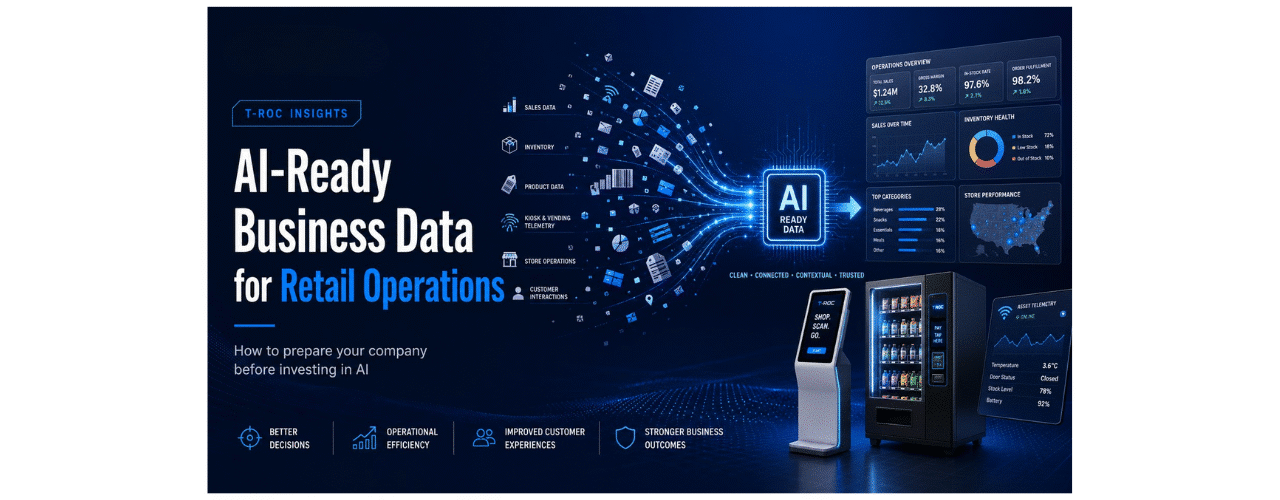
AI-ready business data is information that is accurate, structured, accessible, timely, and connected to real business decisions.
In simple terms, it means your data can be trusted by people, systems, and AI tools.
For a retail organization, this may include:
- Inventory levels
- Machine status
- Transaction data
- Product availability
- Store visit reports
- Planogram compliance
- Customer experience feedback
- Field service activity
- Sales performance
- Replenishment history
- Photo-verified audits
- Real-time issue reporting
The key is not volume alone. A company may have thousands of reports, dashboards, and spreadsheets and still not have AI-ready data.
The real question is: Can your data help AI understand what is happening in the business right now?
Why AI-Ready Business Data Matters in Retail
Retail moves quickly.
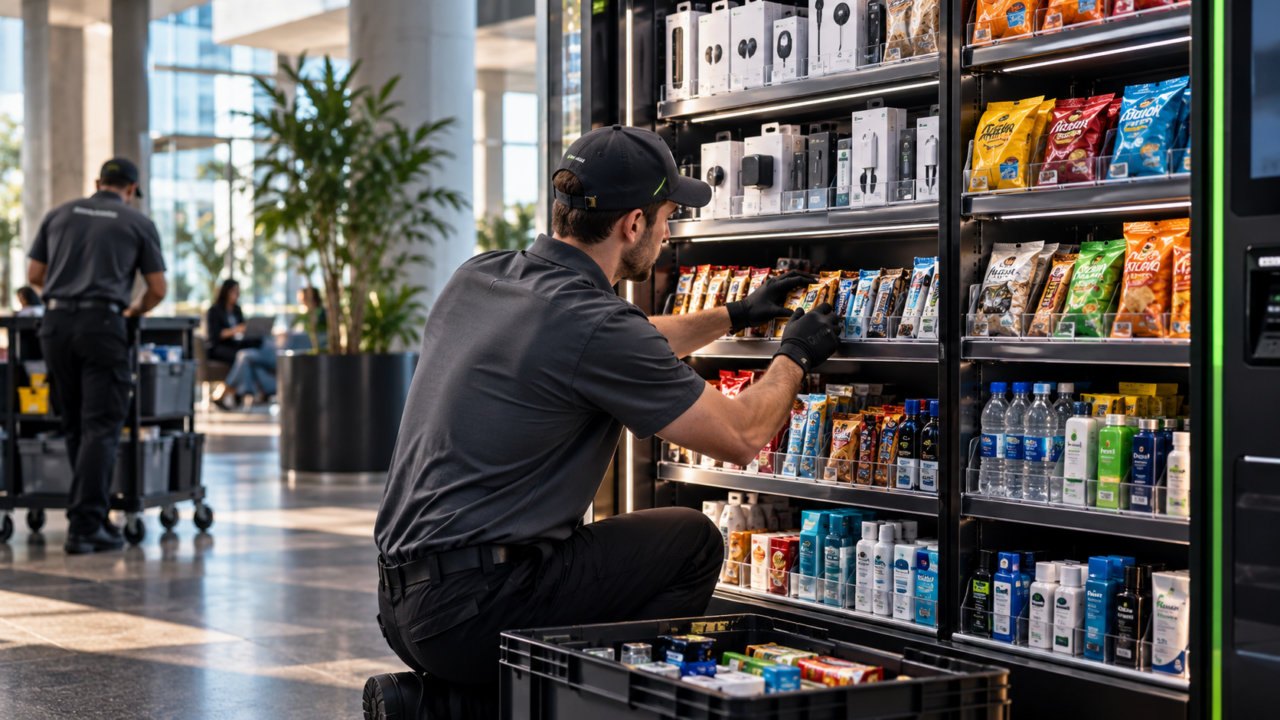
A product can go out of stock during peak traffic. A kiosk can show as “online” but fail to complete transactions. A vending machine can be full but poorly merchandised. A store display can be installed incorrectly. A field issue can be reported too late to protect the sale.
In each case, the value of data depends on timing.
If operational data is captured days or weeks after the issue occurs, AI may still analyze it, but the moment to act has already passed. This is especially true in automated retail, kiosks, and smart vending, where performance depends on uptime, availability, replenishment, and immediate response.
As Brett Beveridge, Founder and CEO of The Revenue Optimization Companies, noted in Forbes Technology Council, operational data must be captured at the source and acted on immediately. Otherwise, the data loses value, and companies risk losing both customers and revenue.
That point is critical.
AI readiness is not only a technology challenge. It is an operational discipline.
AI-Ready Business Data Starts at the Source
Many companies try to solve data problems after the fact. They clean reports, reconcile spreadsheets, or connect systems after inconsistent data has already entered the business.
That approach creates friction.
The better strategy is to improve data capture where the data is created.
For retail and automated retail teams, this means asking:
- Where does the data first appear?
- Who or what captures it?
- Is the input standardized?
- Is the data time-stamped?
- Can the source be verified?
- Is the data connected to a real workflow?
- Can teams act on it immediately?
For example, if a kiosk fails during a high-traffic period, the most valuable data is not a monthly downtime report. The most valuable data is the real-time event: what failed, where it happened, when it happened, what inventory or transaction activity was affected, and whether a field team was dispatched.
That is the type of source-level data AI can use to support better decisions.
The Problem With Fragmented Retail Data
Retail organizations often struggle because data lives in too many places.
One team may track inventory in one platform. Another may track service tickets elsewhere. Sales performance may live in a separate dashboard. Field teams may submit reports manually. Photos may be stored in folders. Customer feedback may sit in survey tools.
Each system may be useful on its own, but AI needs context.
Without context, AI may see activity but miss the business meaning behind it.
For example:
A machine may show “online,” but sales are down.
Inventory may show available, but the product is not visible to customers.
A store visit may be completed, but the issue was never resolved.
A display may be marked installed, but photos show poor execution.
This is where AI-ready business data becomes a competitive advantage. It connects what happened, where it happened, why it matters, and what action should happen next.
Key Qualities of AI-Ready Business Data
To prepare business data for AI, companies should focus on six practical qualities.
1. Accuracy
The data must reflect reality.
If a dashboard says a vending machine is active but customers cannot complete purchases, the data is not accurate enough for AI-driven decision-making.
Accuracy improves when teams capture data directly from operational systems, field activity, transaction events, and verified store-level inputs.
2. Timeliness
Retail data loses value when it arrives too late.
AI tools can help identify patterns, but real-time or near-real-time data is what allows companies to act before lost sales, poor customer experiences, or operational failures multiply.
3. Consistency
Data should follow the same definitions across systems.
For example, “machine down,” “offline,” “out of service,” and “not transacting” may describe similar problems, but if teams use different labels, AI may treat them as separate issues.
Standardized inputs make data easier to analyze and act on.
4. Completeness
Incomplete data creates blind spots.
A service ticket without a location, timestamp, issue type, or resolution status is far less useful. AI needs enough context to understand the full picture.
5. Accessibility
Data must be available to the systems and teams that need it.
If important information is trapped in disconnected systems, spreadsheets, emails, or individual devices, AI cannot use it effectively.
6. Governance
AI-ready data needs ownership.
Teams should know who is responsible for data capture, quality, access, usage rights, and ongoing maintenance. Governance protects both performance and trust.
How to Prepare Business Data for AI
Preparing business data for AI does not require every company to launch a massive transformation project on day one. A better approach is to begin with one high-value workflow.
For retail organizations, that workflow might be:
- Smart vending replenishment
- Kiosk uptime monitoring
- Store audit reporting
- Planogram compliance
- Field service response
- Brand ambassador performance
- Mystery shopping feedback
- Inventory accuracy
- Customer experience recovery
Start with the workflow that has the clearest impact on revenue, customer experience, or operational efficiency.
Then map the data from start to finish.
Step 1: Choose One Business-Critical Workflow
Do not begin with “all company data.”
Begin with one workflow where better data would clearly improve results.
For example, a smart vending operator might choose machine uptime. A retailer might choose store display compliance. A brand might choose field execution quality during a product launch.
The goal is to make one workflow AI-ready before trying to scale across the entire organization.
Step 2: Identify Every Data Source
List every system, person, and process involved in that workflow.
This may include:
- Point-of-sale systems
- Inventory platforms
- IoT machine data
- Field team reports
- Service ticketing systems
- CRM records
- Customer feedback tools
- Photos and audit documentation
- Vendor or partner reports
This step often reveals where data is duplicated, missing, delayed, or manually adjusted.
Step 3: Standardize Data Capture
AI performs better when data is consistent.
Create clear input standards for issue types, location names, product IDs, timestamps, resolution codes, image requirements, and ownership.
For field teams, this may mean using structured checklists instead of open-ended notes. For automated retail, it may mean standardizing how machine status, product availability, and transaction failures are recorded.
Step 4: Connect Data to Business Outcomes
AI-ready business data should not exist in isolation.
Connect operational inputs to outcomes such as:
- Sales lift
- Conversion rate
- Customer satisfaction
- Machine uptime
- Replenishment speed
- Issue resolution time
- Display compliance
- Out-of-stock reduction
- Field visit completion
- Revenue recovery
This helps AI identify what actually matters.
Step 5: Create a Single Operational View
A single operational view does not always mean every piece of data must live in one warehouse.
It means teams and systems need a reliable way to see the full context of a workflow.
For example, a smart vending performance view may combine machine status, transaction data, inventory levels, service history, and field photos. Together, those inputs tell a more complete story than any single data point.
Step 6: Add Human Verification Where It Matters
AI can identify patterns, but some retail realities still need human proof.
Photo verification, field audits, mystery shopping, and store-level checklists can confirm whether what the system reports matches what customers actually experience.
This is especially important when the difference between “reported as complete” and “executed correctly” affects revenue.
AI in Automated Retail Needs Real-Time Operational Data
Automated retail is one of the clearest examples of why AI-ready business data matters.
Kiosks, smart vending machines, and unattended retail systems generate large amounts of data. But data volume does not automatically equal operational intelligence.
A machine can produce status updates, transaction logs, inventory alerts, and error codes. But unless that data is structured, connected, and acted on quickly, the business may still miss the sale.
For automated retail, AI-ready data should answer questions such as:
- Is the machine online and actually transacting?
- Which products are selling fastest?
- Which items are out of stock or close to out of stock?
- Are technical issues recurring by location?
- How quickly are service issues resolved?
- Are customers abandoning purchases?
- Is the assortment aligned with local demand?
- Is the machine clean, visible, stocked, and functioning?
- Are field teams responding within SLA expectations?
These questions require more than dashboards. They require clean operational data captured at the source.
Why “Online” Does Not Always Mean Performing
One of the most common automated retail mistakes is assuming that online status equals business performance.
A machine may be connected but still fail to generate expected revenue.
Possible reasons include:
- Payment issues
- Poor product assortment
- Empty or misplaced inventory
- Screen errors
- Pricing mismatches
- Location-level traffic changes
- Delayed replenishment
- Physical damage
- Poor visibility
- Customer experience friction
AI can help detect these patterns, but only when the underlying data is complete and timely.
For example, if AI sees machine status, sales performance, inventory movement, and service history together, it can help flag problems faster. If it only sees one system, it may miss the real cause.
The Role of Field Teams in AI Data Readiness
AI readiness is not just about software.
In retail, field execution plays a major role in data quality.
Field teams help capture what systems cannot always see:
- Is the display installed correctly?
- Is the product visible?
- Is the machine clean?
- Is signage accurate?
- Is the planogram followed?
- Is the associate trained?
- Is the customer experience consistent?
- Is the issue actually resolved?
This human layer gives AI stronger context.
A photo-verified audit, for example, can validate whether a retail program is being executed as intended. A structured field report can help AI distinguish between a technical issue, a merchandising issue, and a training issue.
That is why the best AI strategies combine technology with real-world operational visibility.
Common Data Problems That Limit AI Performance
Before investing more in AI tools, companies should look for signs of weak data readiness.
Common issues include:
- Data stored across disconnected platforms
- Inconsistent naming conventions
- Manual spreadsheets used as primary records
- Delayed reporting cycles
- Missing timestamps
- Unclear ownership
- Duplicate records
- Poor data governance
- Lack of field verification
- No connection between data and business outcomes
- Too much unstructured information
- Limited access across teams
These problems do not mean AI cannot work. They mean the organization needs to strengthen its data foundation first.
A Practical AI-Ready Data Checklist for Retail Leaders
Use this checklist before scaling AI across retail operations.
Data Capture
- Are key events captured at the source?
- Are inputs standardized?
- Are timestamps included?
- Are location and asset IDs consistent?
- Are photos or verification points required where needed?
Data Quality
- Is the data accurate?
- Is it complete?
- Is it updated quickly enough to support action?
- Are duplicates removed?
- Are definitions consistent across teams?
Data Access
- Can the right teams access the data?
- Can systems share data securely?
- Are important inputs trapped in spreadsheets or emails?
- Can AI tools access the context they need?
Data Governance
- Who owns each data source?
- Who approves changes?
- What data can be used for AI?
- What privacy or security rules apply?
- How is data quality monitored over time?
Business Value
- Which decisions will AI support?
- What workflow will improve first?
- What outcome will be measured?
- How will teams act on AI insights?
- What happens when AI flags an issue?
How T-ROC Helps Make Retail Data More Actionable
T-ROC supports retail brands, automated retail operators, and consumer-facing companies by connecting execution, field visibility, technology, and operational support.
For AI initiatives to succeed in retail, companies need more than strategy. They need real-world data from the environments where customers actually interact with products, people, machines, and services.
That includes:
- Store-level execution insights
- Field team reporting
- Automated retail support
- Smart vending operational visibility
- Merchandising and replenishment support
- Mystery shopping and audits through TCI
- Photo-verified compliance
- Real-time issue identification
- Scalable field coverage
- Data-backed performance improvement
This is where T-ROC’s “Power of And” matters: people and technology working together to close the gap between what a dashboard says and what is really happening in the field.
AI Readiness Is an Operations Advantage
AI-ready business data is not just an IT priority. It is an operations advantage.
When companies improve how data is captured, structured, governed, and connected to outcomes, AI becomes more useful. It can help identify issues faster, recommend better actions, improve forecasting, and support stronger customer experiences.
But when data is fragmented, delayed, or disconnected from the real world, AI has less value.
For retail, kiosk, and smart vending organizations, the path forward is clear: start with the workflows that matter most, capture operational data at the source, standardize the inputs, and connect insights to action.
AI can only improve what it can understand.
And in retail, the best data often starts where execution happens: on the floor, at the machine, in the field, and in the moment.
FAQ: AI-Ready Business Data
What does AI-ready business data mean?
AI-ready business data is data that is accurate, complete, structured, accessible, timely, and governed well enough to support AI tools and business decisions.
Why is AI-ready data important for retail?
Retail decisions often depend on real-time conditions such as inventory, machine uptime, product availability, field execution, and customer experience. If the data is late or inaccurate, AI may produce unreliable recommendations.
How can retailers prepare data for AI?
Retailers can start by choosing one high-value workflow, mapping every data source involved, standardizing how information is captured, connecting data to business outcomes, and improving governance.
Does AI require all data to be centralized?
Not always. The more important goal is giving AI reliable access to the right data and context. In some cases, this may require a centralized data layer. In others, it may require connected systems, APIs, or an operational view across sources.
What is the biggest mistake companies make with AI data?
One of the biggest mistakes is investing in AI tools before fixing the quality, structure, and timeliness of the data. AI cannot create reliable insights from unreliable inputs.
Frequently Asked Questions
What is AI-ready business data?
AI-ready business data is information that is accurate, structured, timely, accessible and directly tied to business decisions. For retail this includes inventory levels, machine status, transaction records, product availability, planogram compliance, photo-verified audits and real-time issue reports that both AI and people can trust and act on.
Why does AI-ready data matter for retail and automated retail?
AI does not fix messy operations, it exposes them. If operational data is late, incomplete or inconsistent, AI will amplify those weaknesses rather than create clarity. Timely, source-verified data is essential to maintain uptime, availability, replenishment and the immediate responses that protect sales and customer experience.
How should we prepare our company before investing in AI?
Start by improving data capture at the source. Map where data first appears, standardize inputs, require timestamps and source verification, and connect data to real workflows so teams can act immediately. Avoid fixing issues after the fact with reconciliations and dashboards. Fix the input process so AI has trustworthy, real-time signals to work from.
Which retail data types should be prioritized for AI use?
Prioritize data that affects availability and actionability: inventory levels, machine uptime and failures, transaction and replenishment history, product availability, store visit and field service reports, planogram compliance, customer experience feedback, and photo-verified audits or real-time issue reports.